Bergamini, Enrico
University of Turin, Italy
enrico.bergamini@unito.it
Mourlon-Druol, Emmanuel
University of Glasgow, UK
Emmanuel.Mourlon-Druol@glasgow.ac.uk
This paper quantitatively explores news coverage on ‘Europe’ through three newspapers, respectively in France, Italy and Germany, by means of a novel big dataset of 13 million full-text daily articles, spanning from 1945 to 2019. The question of how frequently the media have talked about Europe throughout the course of European integration is one of evident relevance.
Analysis of the public debate around given issues in European integration has long been of interest to European studies’ scholars, in particular historians. Some have studied the press based on a specific case study, such as Mathias Haeussler who analysed the debate about Europe in the British popular press through an analysis of the Daily Express and Daily Mirror of the early 1960s (Haeussler 2014). Haeussler stresses the opposing narratives of the two newspapers: the Express opposed European integration, while the Mirror favoured UK’s entry to the EEC.
Diez Medrano used the ‘quality press’ in Germany, Spain, and the UK to shed light on these countries’ different attitudes to European integration. The methodology is based on a close-reading of “a sample of newspaper editorials and opinion pieces published in British, German, and Spanish quality newspapers between 1946 and 1997, the year I ended my fieldwork” (Díez Medrano 2003: 16). In the case of German press, Diez Medrano analysed even years only for the Frankfurter Allgemeine Zeitung, and odd years only for Die Zeit, and concentrated on op-ed articles only (Díez Medrano 2003: 267–269). Reading these articles allowed him to code them into several categories (attitude to European integration and to transfer of sovereignty being two of the most relevant). He used a sample of 90 articles in the Frankfurter Rundschau between 1950 and 1995 to verify his findings, as this journal is more overtly leftist and regionalist (FAZ being conservative-liberal and Die Zeit liberal). The analysis allows Diez Medrano to draw conclusions on the negative and positive comments about European integration (Díez Medrano 2003: 106–156).
Media attention plays an important role in forming public opinion and allowing citizens to form their ideas. Especially following the 2010s, when arguably the European unification process suffered a setback compared to the acceleration of the 1990s, public discourse about Europe, in national media outlets, became even more relevant. But how can we measure the media interest in European affairs? The digitalisation of public archives has opened doors to the application of statistical analysis and natural language processing. Statistical and machine-learning based techniques now make it possible to analyse large amounts of historical data. The combination of digitised databases and computational techniques, at the intersection between humanities and computer science, has helped answer questions from different fields: history, journalism, public opinion and economics (Broersma / Harbers 2018).
Our paper builds in this quantitative direction and focuses on the history of the coverage of the European Union in the news. In a similar context, Müller et al. (2018), have explored the dynamics of the “blame game”, looking at which countries were blamed for the financial crisis. In the aftermath of the financial crisis of 2008, different media in different countries reported different reactions around blame.
Vliegenthart et al. (2008) have investigated the effects of European media presence at the aggregate level, in the context of the European unification process. They explored the role of framing news in terms of benefits or conflict and how this framing affects public opinion and support for the European project. They found that media coverage, especially if framed in terms of conflict, has a significant effect on public opinion. Public opinion was, in this case, proxied by survey data on trust in European institutions and perceived benefits from EU’s membership.
We aim to contribute to the understanding of Europe across European media. Our computational analysis makes use of longer-spanning newspapers archives than previous exercises in the literature, ranging from the end of the Second World War to the end of the 2010s. We collect and organise large web-scraped datasets covering the period from 1945 to 2019 for three relevant newspapers. This large-scale and unprecedented ‘distant reading’ analysis of the digitalised archives of three European newspapers over more than 70 years and 13 million articles allows to identify the overall rising share of European news in printed media. We detail the procedure involved in obtaining and systemising these archives. The archives consist of daily (or weekly in the case of Der Spiegel), full-text articles, collecting all the material present in the web-archives, which has previously been transformed into machine-readable text via OCR. They are intended to proxy for the media narrative, and how we made it as consistent across time and as comparable across countries as possible. We selected three outlets of three of the founding members of the European Union: La Stampa (Italy), Der Spiegel (Germany) and Le Monde (France).
The magnitude of these news archives obviously makes a large-scale manual labelling of the single articles too resource intensive to be possible. We propose a new methodology, after ensuring the quality of the archives, for identifying articles referring to “European” news while leaving aside national and other non-European news, based on a mix of keywords matching, large-scale natural language processing and topic identification on the full text news articles. For example, the archives contain information about sports, which may explicitly refer to Europe, but are outside the scope of our analysis, which considers the “European” topic in its commonly understood institutional, political, and economic sense.
In a first stage, we develop a three-language taxonomy of words that captures very broadly this concept of Europe. We firstly identify the set of articles in the corpus, which match the keywords. In a second stage we identify the topics within it, by performing large-scale Latent Dirichlet Allocation (Blei et al. 2003). By deciding which topics identified are potentially in line with our definition of “Europe”, we further filter down the subset of “European” articles. We propose a method for flagging only the articles more likely to be “European”, based on both the cumulative score coming from the keywords match, and the degree of certainty we have over each topic within the subset. We estimate the topic models for each of the three archives separately: our analysis is language dependent, and it requires building three different models. One of the key parameters to tune when fitting an LDA model is the number of topics potentially present in the corpus. A priori, this number is unknown, particularly when dealing with unstructured data. We run the same model while varying the number of topics and use a common evaluation metric, the coherence score (CV metric), to choose the best performing one. We rely on the MALLET framework (McCallum 2002).
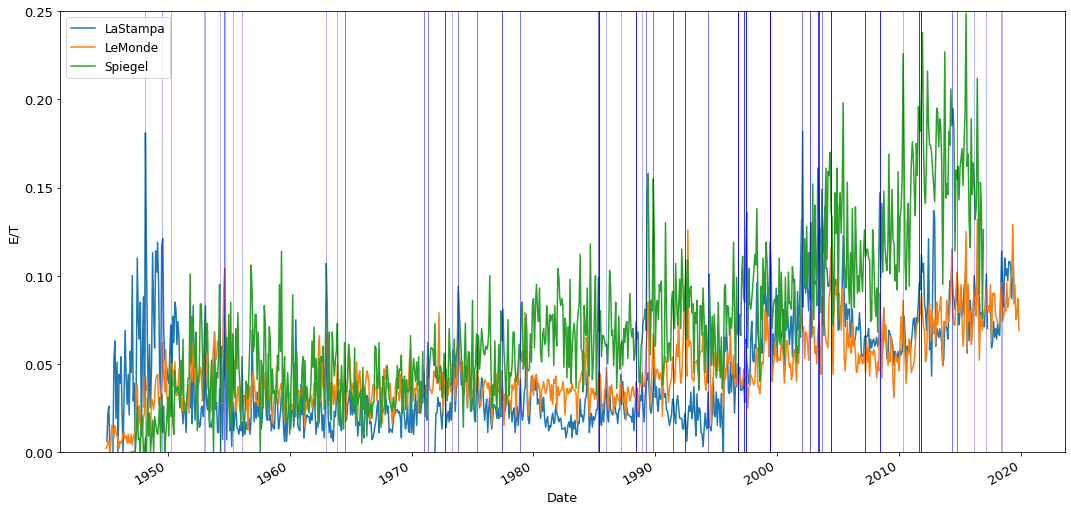
To the state of our knowledge, we believe that our methodological contribution can be of help to scholars aiming at extracting an a-priori defined topic from large and unstructured datasets. Conceptually, we can define a measure of frequency of European news pieces as E/T, where E is the number of European news, while T is the total number of news. We can investigate how this variable evolved over time and across countries. Once articles are classified and the datasets labelled, we perform a time-series analysis, detect salient events of European history, across France, Germany and Italy. We implement a simple z-score algorithm in order to flag events in the three daily time series (Brakel 2020). We analyse these events in light of the evolution of European cooperation and integration since 1945. We find that the most important events in post-war European history are easily identifiable in the archives and that European issues gather substantially greater attention starting in the early 1990s.
Our study thus contributes to considerably widen and systematise the scope of previous studies on the press, thanks to the use of a novel quantitative methodology. This allows us to observe the growth of coverage of European news over national ones, with an acceleration from the mid 1990s. Our study not only confirms that European elections and summits are traditionally high points of media coverage since the end of the Second World War, it also identifies some key milestones in European integration, from the rejection of the European Defence Community in 1954 to the euro crisis summits of the 2010s.