1. The Chansonnier du Roi and the maritem Project
Compiled during the second half of the 13th century, the Chansonnier du Roi (MS Paris, BnF, fr. 844) contains 602 lyrical compositions from different musical and literary traditions: profane songs of French trouvères and Occitan troubadours, French motets, instrumental works and Latin sacred compositions. Moreover, shortly after the original compilation, some additional pieces also from multiple origins (French rondeaux and motets entés, Occitan dansas and descortz) were transcribed in many of the blank pages and columns. Assembling several different repertoires in a uniform plan (further developed through additions), the Chansonnier du Roi is an ideal resource for the study not only of different and multilingual lyric traditions per se, but also of their unitary reception in the late 13th century Gallo-Romance area. This, together with a small but significant presence of lyrics from the 14th century, explains why we chose this manuscript as the object of our research.
The first purpose of the maritem project (anr) is to produce a dataset and digital edition of text and music, encoded in XML/TEI and XML/MEI. If the digital scholarly edition of texts is a well established practice, the field of edition of medieval music is on the other hand relatively new. The Corpus Monodicum project (Haug / Puppe 2020) developped a software, Monodi+, for the musical transcription of medieval latin songs in MEI. We plan to work with the software with a few adaptations and optimisations with the cooperation of the Corpus Monodicum team. The first challenge will be to link the textual edition (TEI) and the musical edition (MEI). In this aspect, the project is pioneer. The choice to work with only one manuscript was made with the perspective to create a prototype and to develop a methodology for the edition and the indexation of all musical chansonniers in different medieval languages (mainly Old French, Old Occitan and Old German). The edition of music and text will prove very useful to both musicologists and philologists, as both aspects will be addressed with equal accuracy.
It is our belief that involving both complementary constituents of medieval lyric songs will bring new results about the history of the codex, the languages, the link between musical composition and language, the history and link between the different traditions, and notably the attribution of the songs.
2. Data pipeline
Acquisition of the text is done with a pipeline that aims to fully integrate the contributions of human and artificial intelligence, in the spirit of digital philology (Andrews 2012). It builds on the workflow developped for another 13th century French manuscript, the Légendier BnF, fr. 412 (Camps et al. 2020).
Layout analysis was performed with Transkribus (Kahle 2017) default model, with some success for text regions and baselines (estim. F measure for baselines according to Transkribus: 0.71). Zones for music and illumination were added and typed manually. We plan to train a more specific model in the future to better detect musical notations and illumination.
The handwritten text recognition was performed using a model trained on data from MS fr. 412, with good results concerning the main hand (CER around 8%, WER 25%). The prediction was then fully corrected by a human expert, inside Transkribus. In the next steps, we aim to reuse and adapt the pipeline for automatic text segmentation, normalisation and lemmatisation (cf. Camps et al. 2020).
For now, the melodies are human-transcribed, but we hope to be able to train a model for music recognition.
3. Towards a scholarly digital edition
The future edition of the Chansonnier du Roi will be an electronic and interactive edition where it will be possible to consult and to query two different textual levels at the same time: the first one will be the allographetic and graphematic transcription of the manuscript (Robinson / Solopova 1993; Stutzmann 2011; Camps 2016), while the second one will be the normalized edition. Both levels will be accompanied by high definition images of all the pages of the manuscript.
Both transcriptions, allographetic and graphematic, are conceived to reflect different aspects of the text as it was written by medieval copyists. An allographetic transcription is a transcription whose goal is to “give access to every form of every letter or sign” (Stutzmann 2011). We followed the recommendations of the Medieval Unicode Font Initiative (Haugen 2015) in order to reproduce the formal Medieval letter variants and abreviations marks. Allographetic transcriptions respect as well the Medieval word segmentation, and punctuation. We decided to transcribe allographetically about one page and a half per copyist (about 20 copyists for the entire manuscript) in order to study the very special usus copiandi of each scribe of the Manuscrit du Roi, and appreciate the very different hands, both French and Italian, which have composed this precious manuscript. Compared to the former, graphematic transcriptions simply normalise variant letter forms.
The second level of the electronic edition of the Chansonnier du Roi is the editorial one, focused on the normalised edition of the lyrical texts, in order to propose a text approachable even for non specialised readers. It modernises the modern word segmentation, use of punctuation, accents and capital letters, and of course the resolution of all the abbreviation marks.
The edition follows the guidelines of the TEI (TEI Consortium 2020) for the text and MEI for musical notations (Music Encoding Initiative 2020). The melodies are transcribed with the software Monodi+ (Eipert et al. 2019). The musical transcription is easier than the text because the notation is clear and simple. The music edition has two levels: a diplomatic transcription with the keys, the signs and the presentation of the manuscrit; and a modernised transcription with a G key and a verse alignment.
4. Stylometric analysis of text and music
The availability of a complete transcription of this manuscript makes possible the stylometric analysis of the songs of the trouvères and trouveresses, at a level impossible until now. This is a critical issue, because disputed attributions are very numerous inside the Old French Lyrical tradition (Gatti 2019), yet it poses specific challenges to both traditional and stylometric approaches:
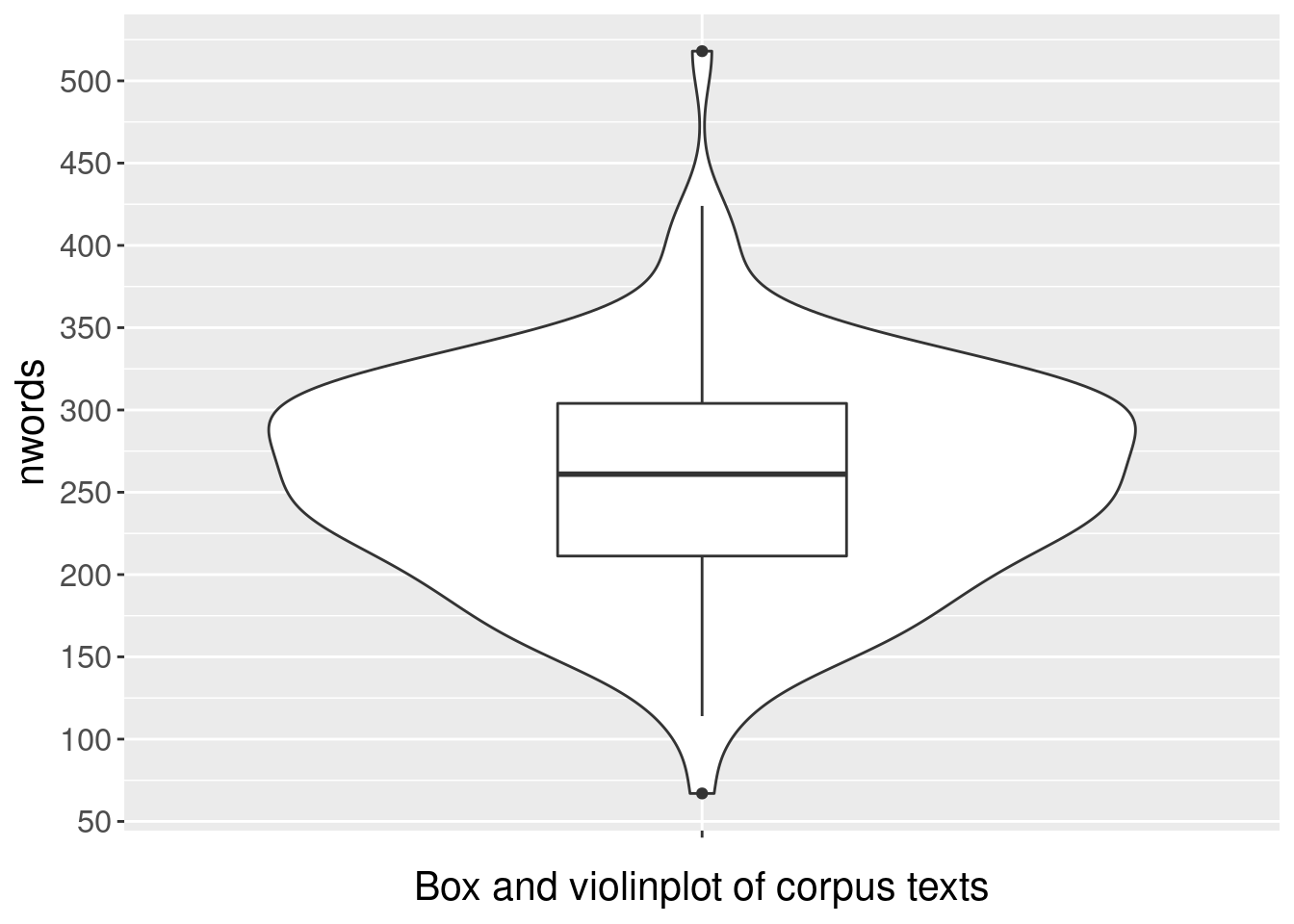
- individual components are very short (fig. 1);
- lyrical idiolect, based on a shared and elitist cultural tradition, is rather homogeneous, apparently leaving little space for personal features, though such a situation is not unheard of in the stylometry of Medieval and Early Modern texts (e.g. Camps / Cafiero 2013; 2019), but still poses significant challenges;
- attribution of the text and of the melody have rarely been addressed as a whole. Indeed, the musical elements (for example: musical curbe, modality, intervals), in connection with the texts could be an important contribution for the knowledge of songs attributions;
- the manuscript tradition creates noise, with both linguistic and substantial variants due to subsequent copy steps upstream of the manuscript which are quite difficult to retrace.
Figure 1: Distribution of the length in words of the texts
An automatic quantitative analysis of the scriptological data (Goebl 1975; Dees 1987), such as graphic and phonetic allotropes in different texts attributed to the same author or in different authorial corpora, will provide useful hints in the linguistically stratified French scriptae of the two main copyists. Thus, not only will it be possible to try to better determine their origins (it’s already acknowledged that one of them is generally Italian, but no previous study could determine with any plausibility the origin of the other, responsible for the main part of the chansonnier), but also to recover valuable insights about the linguistic habits of the authors themselves.
Specifically, the Chansonnier du Roi offers important documentation on the works of Thibaut de Champagne, perhaps the most prominent of all trouvères (Barbieri 1999). The attribution of several songs to Thibaut is still disputed (Wallensköld 1925; Callahan 2010).
In order to give new insights into these disputed attributions, we performed several stylometric analyses, using features robust to noise and short text length, in particular character 3-grams (Camps et al. 2020). Both exploratory and supervised analyses, the latter using SVM, were performed to shed more light on the attribution of these components.
| precis | recall | F_1 |
|---|
| Not Thib. | 76.79 | 1.00 | 0.87 |
| Thibaut | 1.00 | 0.46 | 0.63 |
| GT \ Pred | Not Thib. | Thib |
| Not Thib. | 86 | 0 |
| Thibaut | 26 | 22 |
Table 1: Metrics and confusion matrix for the leave-one-out training
For instance, we trained models on a corpus of 140 songs to distinguish Thibaut’s hand from a group of contemporary trouveres (Gace Brulé, Gautier de Dargies and Blondel de Nesle), with a leave-one-out approach. While the models do not attain a perfect accuracy (global 80.6%), precision reaches 100% for attribution to Thibaut (0.46% recall; table 1). These preliminary results (that we plan to substantially extend for the conference) seem to confirm the attribution to Thibaut of two very famous songs, Ausi com l’unicorne sui ( Linker 240,3; RS 2075) and Li dous penser et li dous souvenir (Linker 240,35; RS 1469) (table 2).
| title | RS | Thibaut |
| Quant fine Amours me proie que je chant | 306 | |
| Sans atente de gueredon | 1867 | |
| Dame, li vostres fins amis | 1516 | |
| Ausi com l’unicorne sui | 2075 | X |
| Tres haute amours, qui tant s’est abessie | 1098 | |
| Li dous penser et li dous souvenir | 1469 | X |
Table 2: Model results for a sample of disputed pieces