Open Stemmata: A Digital Collection of Textual Genealogies

Camps, Jean-Baptiste
École nationale des chartes | PSL, France
jean-baptiste.camps@chartes.psl.eu

Gabay, Simon
Université de Genève
simon.gabay@unige.ch

Riva, Gustavo
Universität Heidelberg
gustavo.fernandez.riva@uni-heidelberg.de

Table of contents

1. Gathering stemmata

Stemma codicum is the genealogical tree of the manuscripts of a given text. More precisely, it is a tool of textual criticism that represents the relationships between all the witnesses of a specific work (Duval 2015; Roelli 2020) under the form of a tree, or, in the case of contamination, a directed acyclic graph (Andrews / Macé 2012). The first stemmata were drawn in the 1830’s, with at least one antecedent in the 18th century, while the method to build them progressively took form during the 19th century and is best called the “common errors” method (Camps / Cafiero 2014).

In a stemma, the relationships between the witnesses and the hypothetical necessary (lost) nodes are represented with a tree-like structure (cf. fig. 1). The original purpose of the stemma is to allow for the reconstruction of the archetype or the original text, as conceived by its author, but stemmata are also used to study the transmission and the reception of works over centuries (Marshall / Leighton Durham 1998), though this has sometimes spurred some debate (Varvaro 2010; Croenen 2010).

Historically, (personal) collections of stemmata have been used in epistemological debates on the common error methods. Joseph Bedier reports that he took the habit of tracing the stemmata he encountered, and built a collection of 110 stemmata, out of which he construed his remarks on the bifidity, from which he derived his criticism of the common error methods (Bédier 1928). To falsify or confirm Bédier’s claims, other scholars have replicated his endeavour, building their own collection (Shepard 1930; Castellani 1957; Haugen 2015) but, as far as we noticed, there is yet no publicly available digital collection of stemmata.

A publicly available collection of stemmata would have a great interest, because controversies on their shape are at the heart of the great philological debate of the 20th century, at least for Romance Philology, where Bédier claims led some philologists to renounce the common error method (e.g. in France), while it gave other philological schools the necessary impulse to try and refine it (e.g., in Italy, see Trovato 2014) 1. The development of computational philology has been a good opportunity to think anew this old art (Hoenen 2020).

Moreover, study on the shapes of stemmata could prove interesting in many kinds of analysis, be it on the dissemination, reception and history of texts, or to be compared to more theoretical models.

All of this triggers the need for a digital collections of stemmata, for mining and testing purposes. This paper presents an attempt to answer this need. We therefore propose to collect all available stemmata and encode them (cf. fig. 1a). Chronological and linguistic boundaries are very open: at least any European language is accepted, from every time period, even if we will focus first on Western Medieval languages (esp. French, Occitan, Italian, German, Spanish and of course Latin).
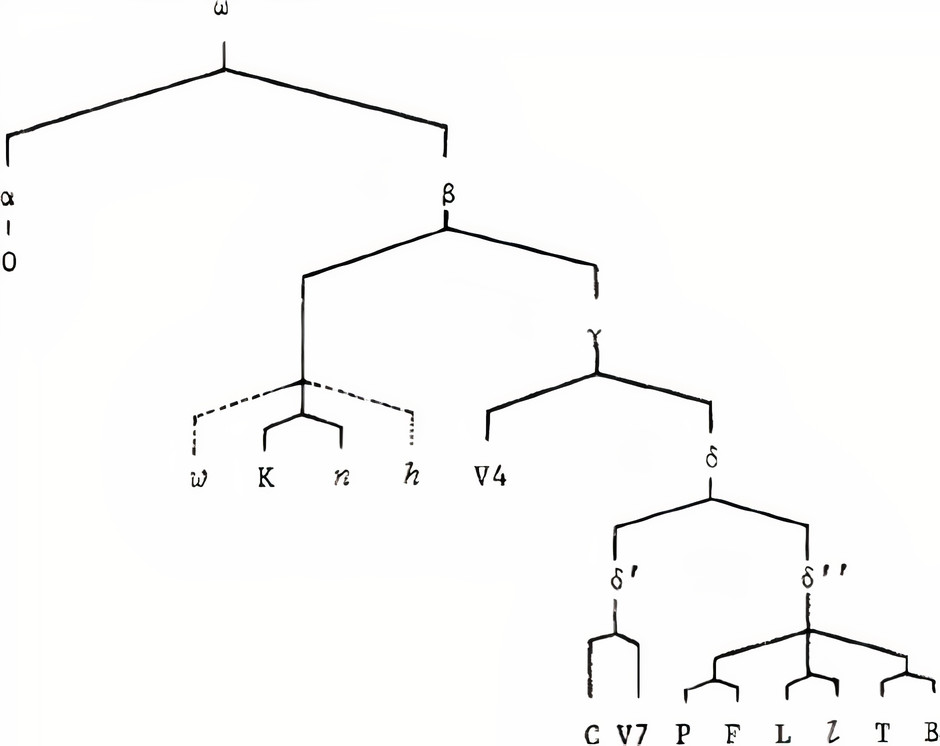
Figure 1a: Segre’s original stemma
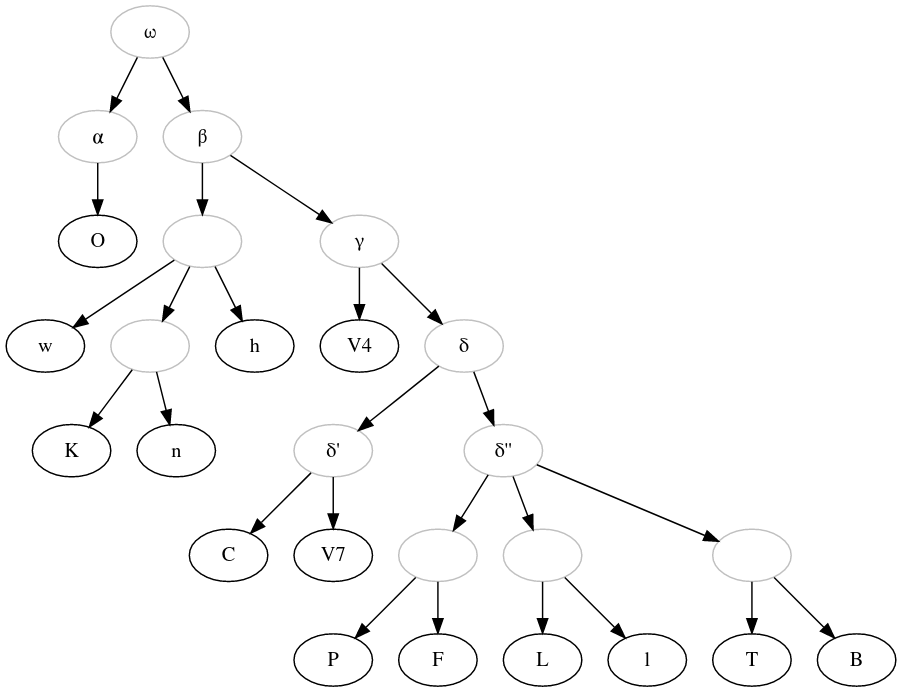
Figure 2b: Graph visualisation of Segre’s stemma
2. Information, modelling and production

Open Stemmata is a collaborative project, where researchers can participate by sharing stemmata that they encode. Guidelines have been published to help volunteers (OpenStemmata 2021), who are required to provide three documents for each stemma:

Metedata are produced with an online form 2 to ensure the homogeneity and the completeness of the data. Minimal standardisation is offered via VIAF (OCLC 2020) for author and work, and ORCID (ORCID 2021) for submission contributor.

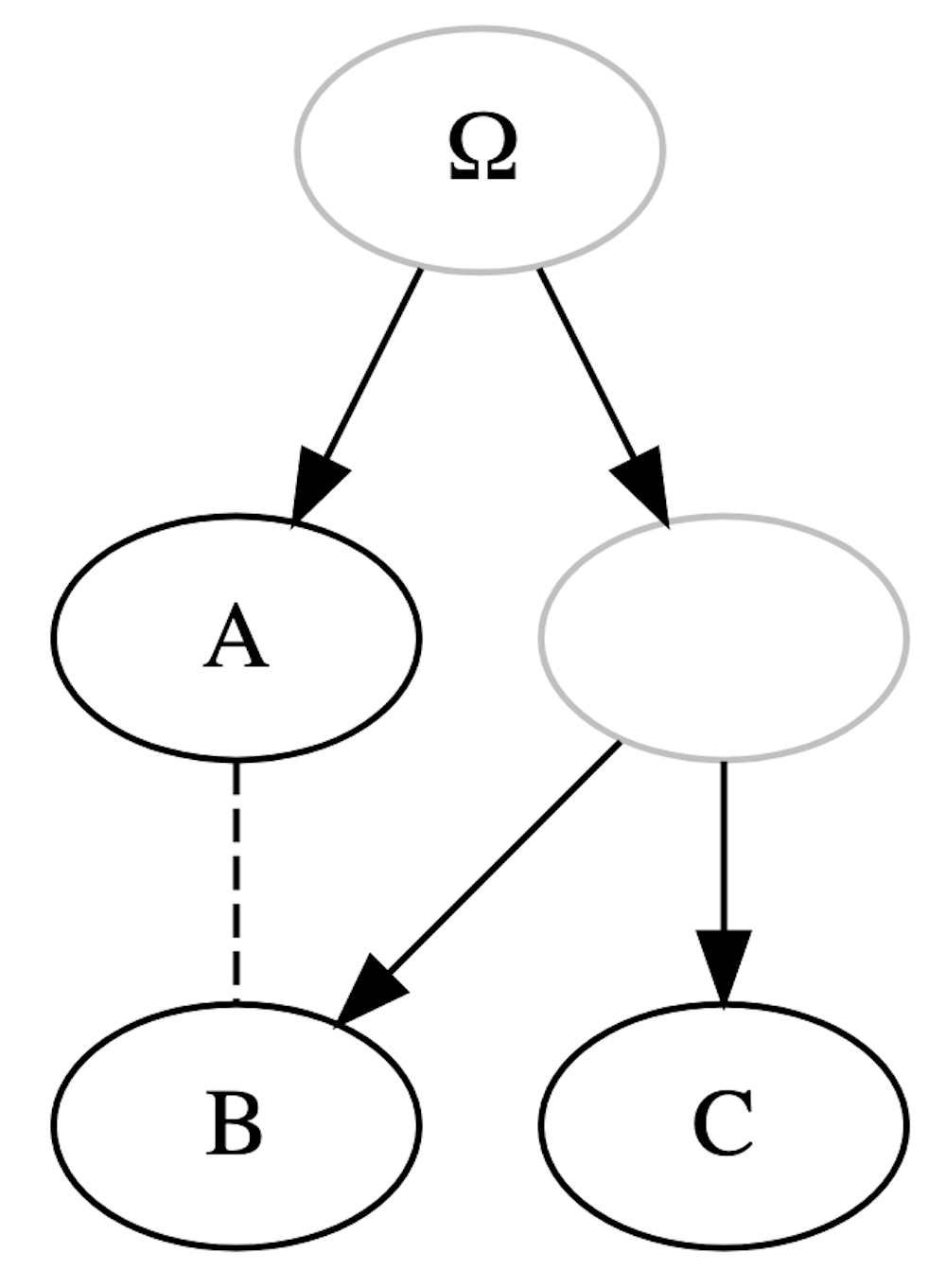
A stemma being a graph, we have decided to encode data with the DOT language (Graphviz 2021) (fig. 3) which provides all the subtlety required and has a simple syntax that enables easy manual encoding. Hypothetical nodes are identified with “grey” as the value of the color attribute, contamination as dashed lines. We suggest the use of an online graphviz editor (“Edotor,” n.d.), but many other options are available.

Figure 3: Example of graph and its encoding in DOT language

digraph {

omega[label="Ω", color="grey"];

omega ->A;

omega -> 1;

1 -> B;

1 -> C;

1[label="", color="grey"];

A -> B [style="dashed", dir=none];

}

On top of the online form for the metadata, additional steps are in place to ensure data quality, documentation and re-usability.

3. Present and Future of OpenStemmata

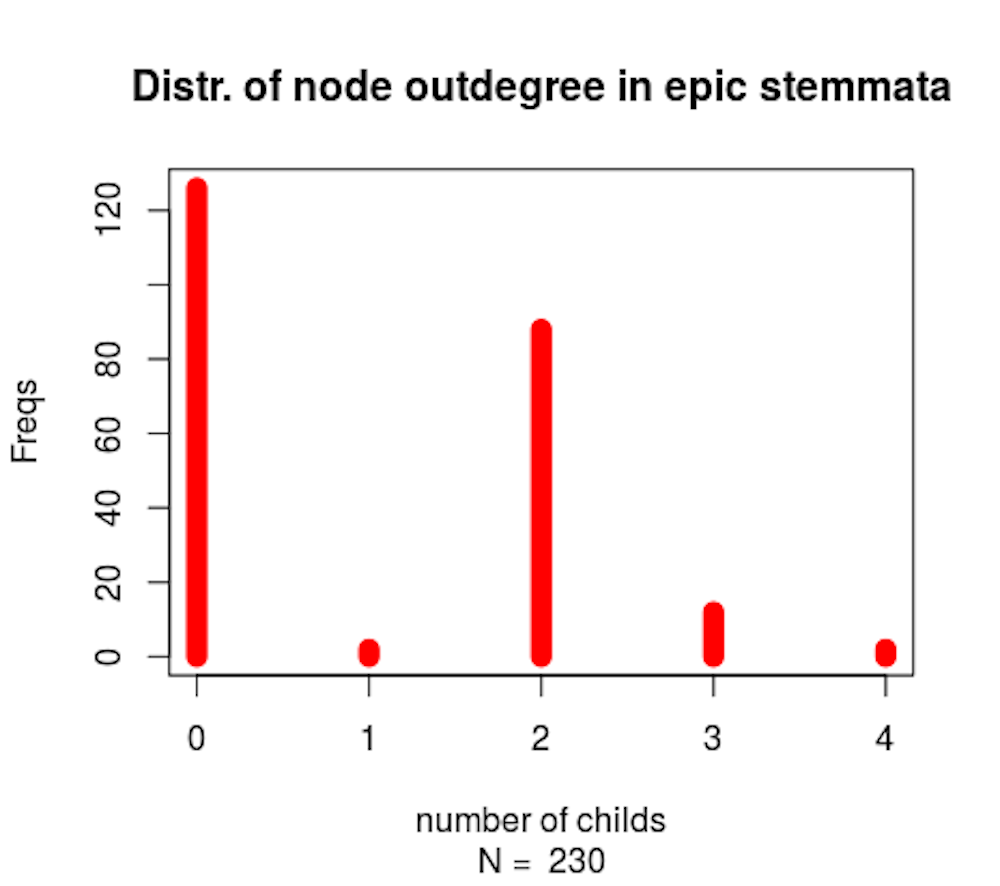
At present, there are roughly 50 stemmata available in the database, most of them concerning Old French traditions. In the future, we hope to have a coverage as exhaustive as possible. Such data will allow many kinds of analyses on the shape of stemmata, including comparative or specific analyses for different types of traditions (fig. 4).

Figure 4: Distribution of nodes (witnesses and hypothetical nodes) in a collection of Old French Epic stemmata ( Chansons de geste)

Appendix A

Bibliography
  1. Andrews, Tara / Macé, Caroline (2012):. “Trees of Texts: Models and Methods for an Updated Theory of Medieval Text Stemmatology Digital Humanities 2012”, in: DH 2012. Hamburg <http://www.dh2012.uni-hamburg.de/conference/programme/abstracts/trees-of-texts-models-and-methods-for-an-updated-theory-of-medieval-text-stemmatology.1.html>.
  2. Bédier, Joseph (1928): “La Tradition Manuscrite Du Lai de L’ombre : Réflexions Sur L’art d’éditer Les Anciens Textes”, in: Romania 54: 161–196, 321–356 DOI https://doi.org/10.3406/roma.1928.4345.
  3. Camps, Jean-Baptiste / Cafiero, Florian(2014): “Genealogical Variant Locations and Simplified Stemma: A Test Case”, in: Analysis of Ancient and Medieval Texts and Manuscripts: Digital Approaches (edited by Tara Andrews and Caroline Macé) (= Lectio 1). Turnhout: Brepols 69–93 DOI: https://doi.org/10.1484/M.LECTIO-EB.5.102565.
  4. Carsten-Peust, Konstanz (2012): “The Stemma of the Story of Sinuhe. Or: How to Use an Unrooted Phylogenetic Tree in Textual Criticism”, in: Lingua Aegyptia 20: 209–220 DOI: https://doi.org/10.11588/propylaeumdok.00002543.
  5. Castellani, Arrigo (1957): Bédier Avait-Il Raison?: La Méthode de Lachmann Dans Les éditions de Textes Du Moyen Age (= Discours Universitaires, Nouvelle Série / Freiburger Universitätsreden, Neue Folge 20). Freiburg / Schweiz : Universitätsverlag / Fribourg: Suisse. Éditions Universitaires.
  6. Croenen, Godfried (2010): “Stemmata, Philology and Textual History: A Response to Alberto Varvaro”, in: Medioevo Romanzo 34: 422–426.
  7. Duval, Frédéric (2015): Les Mots de L’édition de Textes. Magister. Paris: École nationale des chartes.
  8. Edotor ( n.d.) <https://edotor.net/>.
  9. Graphviz (2021): "The Dot Language: Documentation" <https://www.graphviz.org/doc/info/lang.html>.
  10. Haugen, Odd Einar (2015): “The Silva Portentosa of Stemmatology: Bifurcation in the Recension of Old Norse Manuscripts”, in: Digital Scholarship in the Humanities 31, 3: 594–610 DOI: https://doi.org/10.1093/llc/fqv002.
  11. Hoenen, Armin (2020): “History of Computer-Assisted Stemmatology”, in: Handbook of Stemmatology: History, Methodology, Digital Approaches. Berlin: De Gruyter 294–303 DOI: https://doi.org/10.1515/9783110684384-006.
  12. Marshall, Peter K. / Leighton Durham, Reynolds (1998): Texts and Transmission: A Survey of the Latin Classics. Oxford: Clarendon Press.
  13. OCLC (2020): “Virtual International Authority File (VIAF)” <https://viaf.org/>.
  14. OpenStemmata (2021): "Guidelines" <https://openstemmata.github.io/guidelines.html>.
  15. ORCID (2021): “Open Researcher and Contributor ID” <https://orcid.org/>.
  16. Perugi, Maurizio (ed.) (2000): La Vie de Saint Alexis (= Textes Littéraires Français 529). Genève: Droz.
  17. Roelli, Philipp (2020): Handbook of Stemmatology: History, Methodology, Digital Approaches. Berlin: De Gruyter DOI: https://doi.org/10.1515/9783110684384.
  18. Shepard, William P. (1930): “Recent Theories of Textual Criticism”, in: Modern Philology 28, 2: 129–141.
  19. TEI Consortium (2020): TEI P5: Guidelines for Electronic Text Encoding and Interchange (version Version 4.1.0) <https://tei-c.org/Guidelines/>.
  20. Trovato, Paolo (2014): “Bédier’s Contribution to the Accomplishment of Stemmatic Method: An Italian Perspective”, in: Textual Cultures 9, 1: 160–176.
  21. Varvaro, Alberto (2010): “Un Nuovo Studio Sulla Tradizione Delle Chroniques Di Jean Froissart”, in: Medioevo Romanzo 34: 145–152.
  22. Zufferey, François (2007): “La Tradition Manuscrite Du Saint Alexis Primitif”, in: Romania 125, 497: 1–45 DOI: https://doi.org/10.3406/roma.2007.1387.
Notes
1.
This even led some philologists to suggest alternatives to the tree-like structure, such as Venn diagram, unrooted graphs…(Carsten-Peust 2012). In the case of some very complex traditions, some editors renounce to draw a stemma (Perugi 2000); comp. to (Zufferey 2007).
2.
Available on: https://openstemmata.github.io/document-your-stemma.html.