1. Introduction
Work on the Russian Drama Corpora (RusDraCor) started in 2017 at Higher School of Economics in Moscow. The growing corpus now contains 212 Russian-language plays with publication dates ranging from the 1740s to the 1940s. The main sources for plays in RusDraCor include Wikisource (https://ru.wikisource.org/), the Russian Virtual Library (https://rvb.ru/), the Online Library Alexei Komarov (https://ilibrary.ru/) and Maksim Moshkow’s Library (http://lib.ru/). All plays were converted to TEI (P5), corrected and enriched in various ways.
RusDraCor started as an independent project (Skorinkin et al. 2018), but is now one of the in-house corpora of the DraCor research portal. To date, the platform features 12 corpora of plays from various sources (including general-purpose ones in French, German, Italian and Swedish, but also specialised corpora comprising plays by Shakespeare or Calderón). DraCor is a showcase for the “Programmable Corpora” concept (Fischer et al. 2019) and as such provides easy access to all levels of encoded data. It features an API enabling researchers to pinpoint access to specific parts of the data and also provides a SPARQL endpoint to connect all corpora to the Linked Open Data cloud. By providing easy access to corpora in different (mostly European) languages, it allows for a comparative, transnational and translingual perspective on the history of European drama.
One of the DraCor functions is to extract co-occurrence networks of plays off-the-shelf, including some precalculated network metrics. Network data can be downloaded in different formats (CSV, GEXF, GraphML) and are ready to be used in more complex network analysis software. The data contains information on character co-occurrences, the gender of characters and their word space (i.e., number of words spoken).
This paper describes how we enriched the data in terms of kinship and social relations. We detail the annotation workflow (chapter 2) and demonstrate a use-case scenario leading to the linguistic analysis of different vocabulary used by parents and children in Russian drama (chapter 3).
2. Labeling Character Relations
The idea of adding kinship and social relations originates in the work of the QuaDramA group (Quantitative Drama Analytics) based at Stuttgart University. They extracted and labeled character relations for the entire German Drama Corpus and integrated their results into the mainstream corpus (Wiedmer et al. 2020). We followed their suggestion for a corresponding vocabulary and aimed at annotating character relations in the entire RusDraCor.
Let us take a closer look at Russian drama. If we recall canonised plays like “The Government Inspector” (“Ревизор”) by Nikolai Gogol, “Woe from Wit” (“Горе от ума”) by Alexander Griboyedov, “Three Sisters” (“Три сестры”) by Anton Chekhov, the family comedies by Fonvizin or the wide range of family dramas of the 19th century (think Ostrovsky) – they all feature plots revolving around family constellations, especially problematising relations between parents and their children. In some cases, family relations are even recognisable in the title (“Three Sisters”), but a complete list of family relations could only be extracted by close reading. Since this was not feasible given the size of the corpus, we relied on the original cast lists provided for the majority of plays, featuring pretty complete information on kinship and social relations.
A cast list is already provided in the first modern Russian drama, Sumarokov’s tragedy “Khorev” (1747), and, in fact, we only counted 28 out of 212 Russian plays that did not feature a cast list. Kinship information is usually registered by simple descriptions like “son of”, “sister of”, “father of” etc. Based on this fairly stable wording, we extracted and annotated character relations. Additional markup was added in a fork from the main git repository and then merged into mainstream and is now part of the standard offerings of RusDraCor.
Although our data enhancement should in itself be beneficial to the research community, it was also driven by a concrete research question. Once we would have the relational status of characters in a machine-readable format, we could easily extract and compare the language used by parents and children. We could now also investigate if an author really managed to craft a measurably distinct voice for different types of characters, e.g., fathers vs. mothers, brothers vs. sisters, or parents vs. children.
As stated above, we built on the annotation scheme used by the QuaDramA group to annotate seven kinds of relations (Table 1).
Table 1: Annotation scheme.
| Relation label | Directed/Undirected | Description |
| parent_of | directed | One character is a parent of the other |
| lover_of | directed | For lovers |
| related_with | directed | Other family relations (e.g., uncles) |
| associated_with | directed | For clearly associated characters (e.g., butlers) |
| siblings | undirected | Characters that have at least one parent in common |
| spouses | undirected | Characters in marriage (or engaged) |
| friends | undirected | Characters marked as being friends |
Relations are stored in TEI in the <listRelation> element within the <listPerson> node. Directed relations are encoded with the attributes “active” and “passive”. Undirected relations use the “mutual” attribute.
As an example, here is the cast list for Fonvizin’s comedy “The Minor” (“Недоросль”), followed by the annotations in TEI:
- Простаков.
- Г-жа Простакова, жена его.
- Митрофан, сын их, недоросль.
- Еремеевна, мама Митрофанова.
- Правдин.
- Стародум.
- Софья, племянница Стародума.
- Милон.
- Скотинин, брат г-жи Простаковой.
- Кутейкин, семинарист.
- Цыфиркин, отставной сержант.
- Вральман, учитель.
- Тришка, портной.
- Слуга Простакова.
- Камердинер Стародума.
<listPerson>
[…]
<listRelation type="personal">
<relation name="spouses" mutual="#prostakov #gospozha_prostakova"/>
<relation name="parent_of" active="#gospozha_prostakova #prostakov" passive="#mitrofan"/>
<relation name="associated_with" active="#eremeevna" passive="#mitrofan"/>
<relation name="related_with" active="#sofja" passive="#starodum"/>
<relation name="associated_with" active="#sluga" passive="#prostakov"/>
<relation name="siblings" mutual="#skotinin #gospozha_prostakova"/>
<relation name="associated_with" active="#kamerdiner" passive="#starodum"/>
</listRelation>
</listPerson>
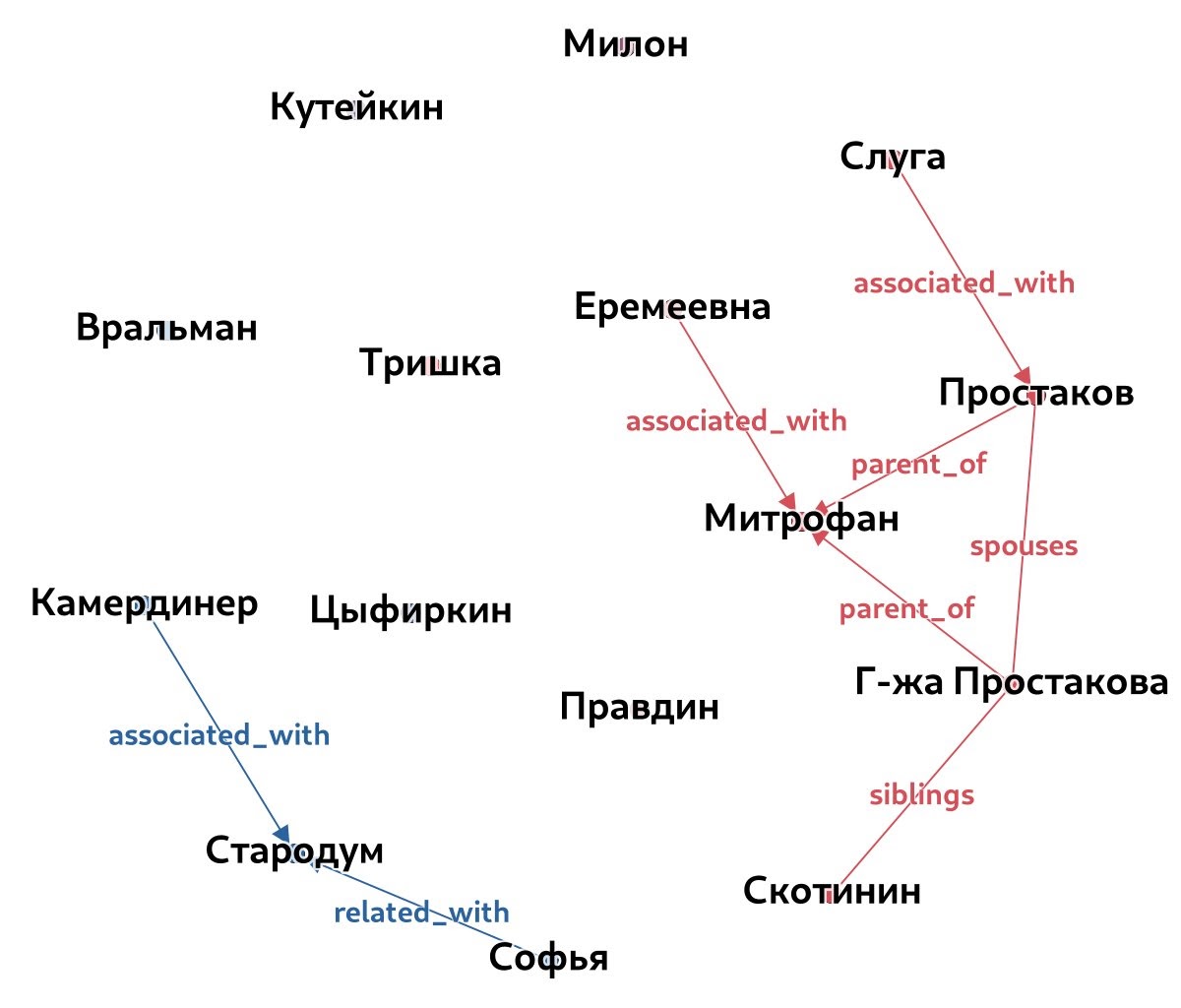
In parallel to finishing and correcting the relations, a new function called “relations” was implemented in the DraCor API (https://dracor.org/documentation/api). Relational data is provided as network data out-of-the-box (in CSV and GEXF formats). This ready-to-use data can easily be visualised as a graph as demonstrated in Figure 1.
Figure 1: Kinship and social relations extracted from Fonvizin’s “The Minor” and visualised with Gephi.
3. First Experiments with stylo()
An already existing mechanism of the API, the “spoken text” function, was enhanced with a “relation” option, meaning that you can now extract spoken text based on the relational status of characters. Our annotation of relations is free of gender implications (e.g., mothers and fathers were equally encoded as “parents”), but since RusDraCor characters are already marked-up with gender info, this in combination with their “relation” status allows us to finegrain access to, say, spoken text uttered by mothers or sons. Corresponding API query strings for “The Minor” look like this:
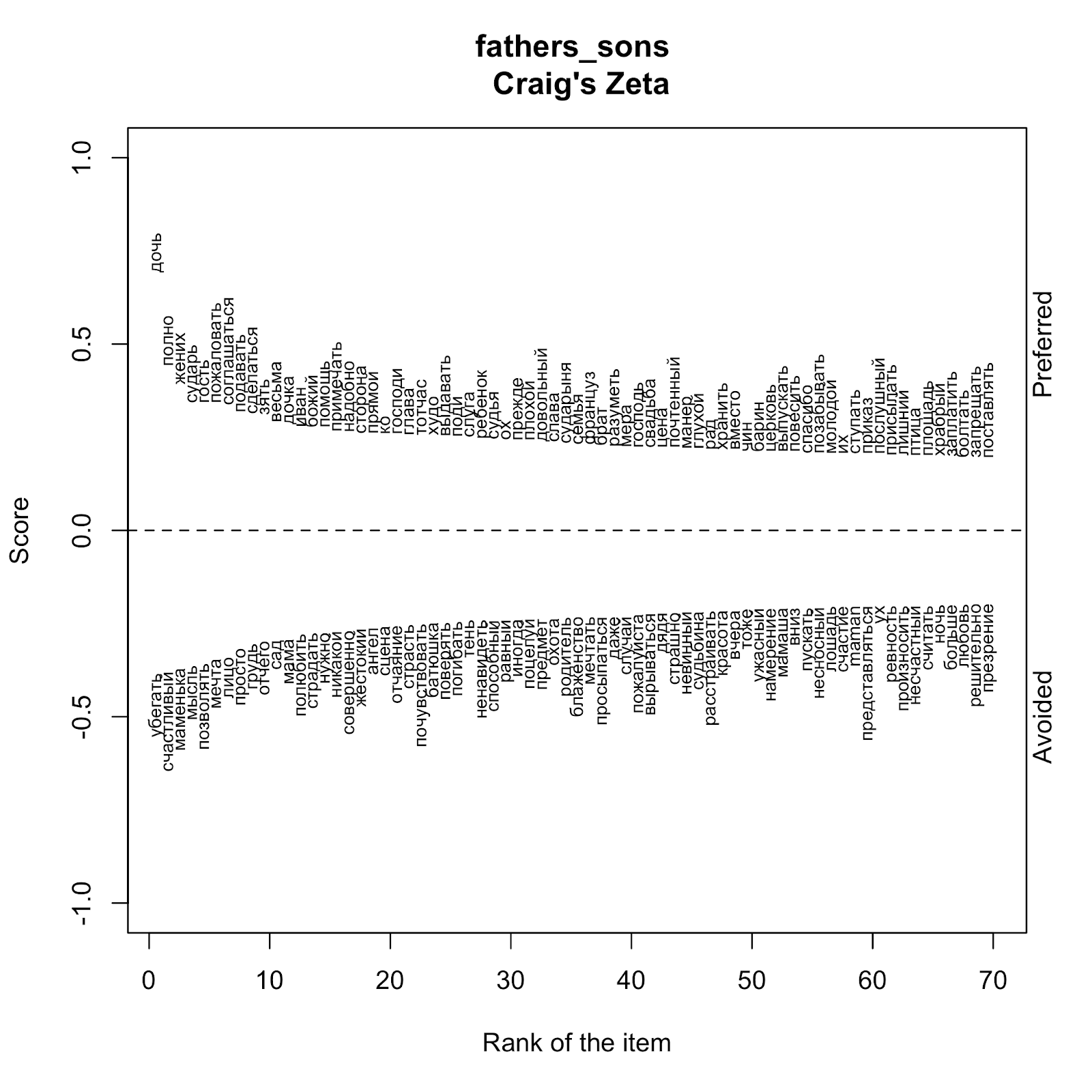
In this fashion, we can download spoken texts of fathers, mothers, sons and daughters for all plays in the corpus in one go. It is now easy to compare the vocabulary of, for example, sons and fathers in all Russian plays from the 1740s to the 1940s. After a lemmatisation step via MyStem, we used Craig’s Zeta function as implemented in stylo(), which yielded the following result:
Figure 2: Most distinctive words: fathers (Preferred) vs. sons (Avoided).
The first obvious thing which could also serve as a proof of concept, is that the most distinctive word that fathers use in comparison to sons is “дочь” (“daughter”). The most distinctive noun for sons is “маменька” (“mom”). Sons also resort to using words that express feelings more than their fatherly counterparts (i.e., “полюбить” = “to fall in love”, “страдать” = “to suffer”, “страсть” = “passion”). Fathers in general talk more about family members, marriage, service and ranks; sons are more concerned with love, fate, beauty, happiness.
An analysis sensitive to time periods instead of throwing together 200 years of drama history would provide much more meaningful data in this case. But this short application may serve as an example for the benefits of deep annotation and for how you can use it to address quantitative research questions.
4. Conclusion
In this paper, we described the enrichment of an existing corpus of Russian plays with data on kinship and social relations of characters. We integrated the results into the mainstream corpus so that it can be of use for other researchers. We also described two new functions of the DraCor API that use these annotations to facilitate access to them. This workflow, inspired by the work of the QuaDramA group, is repeatable for corpora in other languages. We also showed how we can extract data based on our annotation work and analyse the language of different types of characters based on their relational status. We also correlated social network data with corresponding linguistic data in a large-scale fashion, which will hopefully inspire further work on the subject.