1. The context of sermons
Literary worlds centre on a gallery of characters situated in temporal and spatial contexts, in which other subjects and objects exist (Vosmar 1969: 89-101). More generally, within narrative theory it has been argued that humans fundamentally understand the world through narratives (Fludernik 1996; Herman 2004; Nielsen 2010: 173). As such, narratives can establish coherence between past and present (Polkinghorne 1988: 21). In this presentation, we ask a number of questions related to the unfolding of a character gallery in contemporary Danish sermons: Which characters populate Danish sermons? How do pastors adapt these characters in their sermons? What does the encounter between characters tell us about preaching practices today?
Sermons are theological and religious texts produced by local pastors and are addressed to the congregation at weekly Sunday service. Elucidating a biblical text is at the heart of the interaction between preacher and listener, and this entails incorporating a range of biblical figures into a sermon. However, sermons are mediated in a ‘here and now’, potentially inviting an entirely different range of characters. Similarly, sermons must also be understood as a collective practice fostered by theological and pastoral training, ecclesial tradition, as well as cultural history. To learn more about the collective practice of preaching rather than single cases, we study this phenomenon in a larger corpus of sermons.
2. Data extraction
We take our data from a newly-established corpus of 11,955 sermons from 95 different pastors in the Evangelical Lutheran Church in Denmark ( ELCD; Agersnap et al. 2020). The corpus was sampled directly from pastors and is accompanied by metadata concerning the context of each sermon (date, holiday, parish size and diocese as well as the pastor’s gender, age and place of education). Approximately 96% of the sermons were written between 2011 and 2016, while a limited number were written on either side of this period. There is also a small number of sermons for which we have no date (≈0.02%).
We used named entity recognition to extract occurrences of named individuals from the sermons, identifying 12,357 unique personal entities in the corpus. We chose to include only entities that occurred 10 or more times in the corpus, reducing our data considerably to 966 entities, many of which referred to the same characters with different spellings, misspellings and possessive forms. We manually corrected these spellings and concatenated entities into a final set of 600 unique characters.
A schema was constructed for labelling character types, shown in Table 1 below. We coded each character as one of four types. B characters are those from biblical sources; N characters are non-biblical but specific individuals (for example, C.S. Lewis); P characters are non-specific characters with generic proper names ( Anders); and R characters are named according to a social role or characteristic ( Enken (the widow) or Kongen (the King). B_a characters and N_a characters are entities that most likely refer to biblical characters or non-biblical specific characters due to their high frequency scores but that are also common Danish names, such as Maria (Mary) or Johannes (John). Additional labels include a character’s gender, temporal information, nationality, and the cultural domain(s) to which they belong.
Table 1: Character coding schema
3. Exploring the character gallery
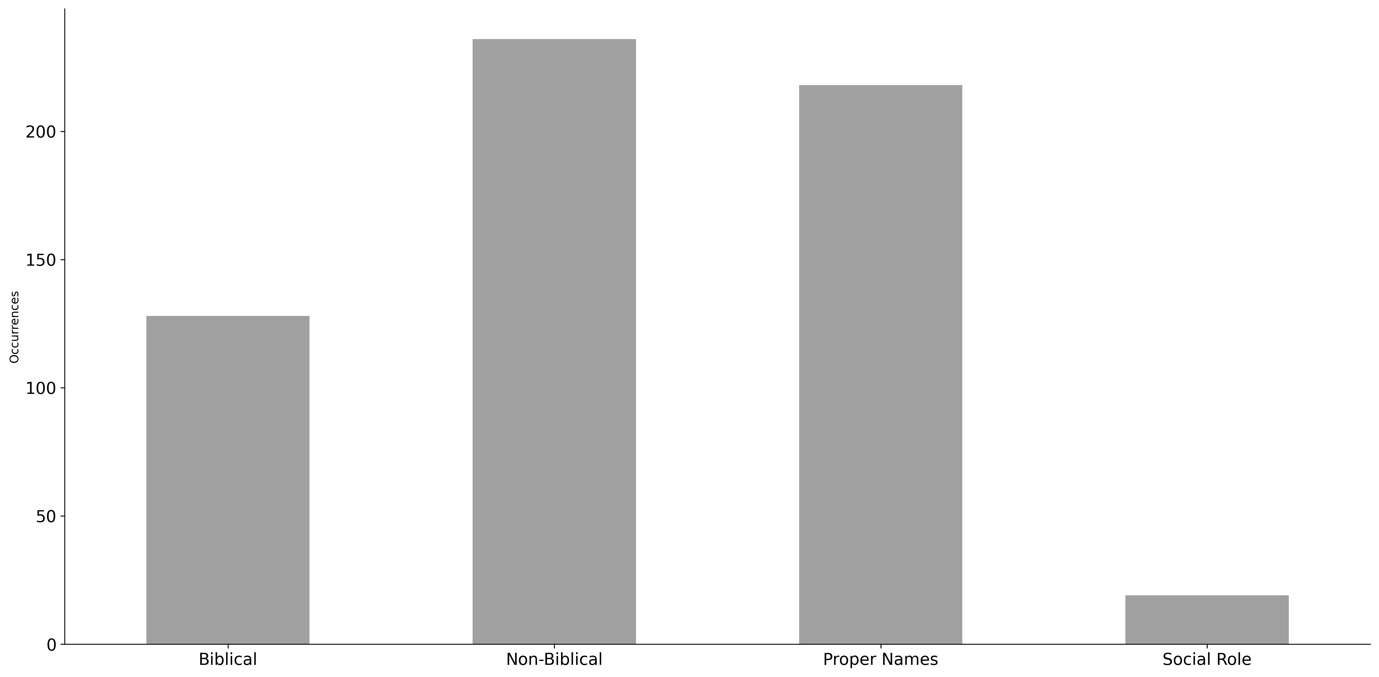
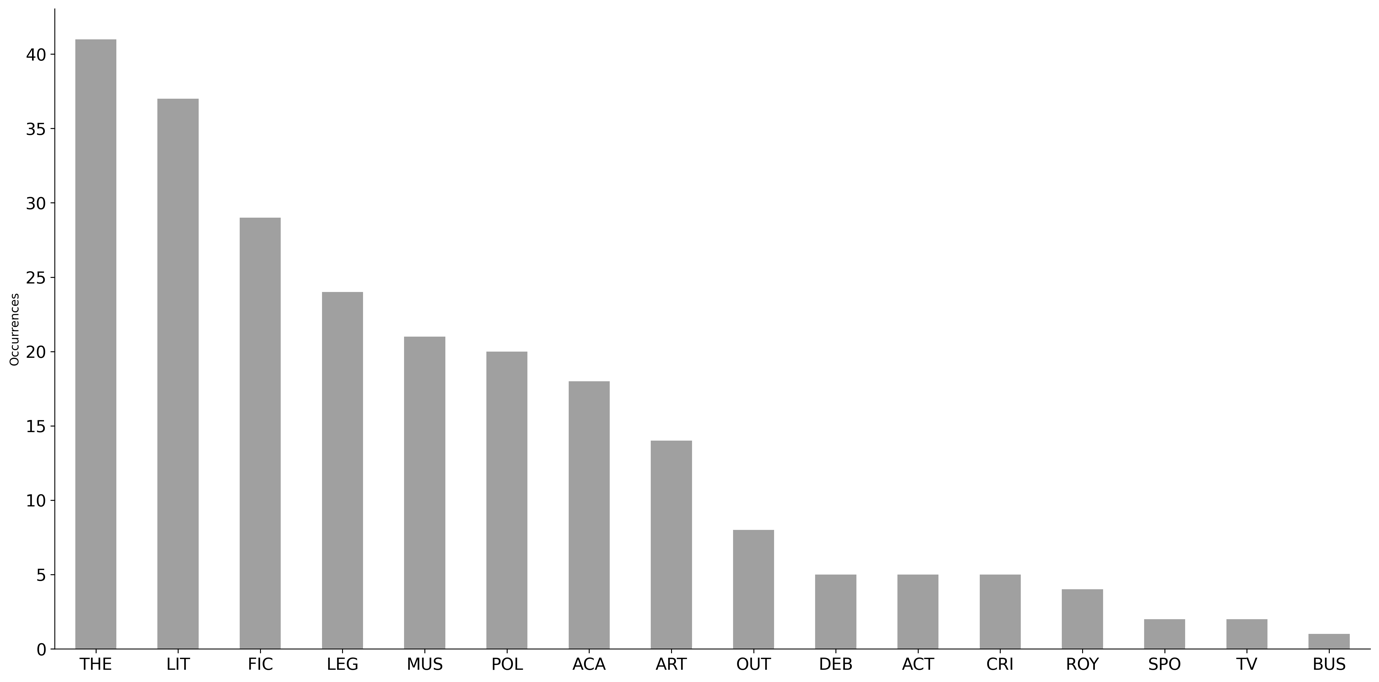
In terms of raw distribution, the total occurrence of biblical characters is overwhelmingly greater than other categories, as illustrated in Figure 1 below. This is unsurprising, given the nature of the corpus that we are dealing with. Pastors are expected to interpret biblical sources in their sermons, and so we should expect to see a predominance of these characters. Figure 2 illustrates the number of unique characters from each category, where we can see that non-biblical characters outnumber the number of biblical characters. Figure 3 narrows in on this, showing the subcategories comprising the non-biblical category. The dominant subcategory are those considered to be theologians. From the remaining cultural domains, we find that pastors seem to prioritise primarily literature (LIT), politics (POL) and art (ART). In comparison, characters from more popular cultural platforms, such as radio (RAD), television (TV) or social media (SOC), are represented to a much lesser degree. Some labels, such as RAD, REA or SOC, are not plotted in Figure 3, due to limited representations in the data.
Figure 1: Total number of biblical and non-biblical person entities in the corpus
Figure 2: Number of unique biblical and non-biblical entities in the corpus
Figure 3: Distribution of cultural domains among non-biblical characters
We adopted the perspective of social network analysis to explore the character gallery in more detail and to attempt to model the relationship between individual characters. This method has been applied with great success across a range of topics in the humanities, from the structure of dramatic texts (Stiller et al. 2003; Fischer et al. 2017) to 16 th-century protestant letter writing in England (Ahnert / Ahnert 2015). For our purposes, each of the 600 named entities constitutes a node in the network. An edge is created between characters if they occur together in a sermon. Edges are weighted by the number of shared sermons: that is, characters who appear together regularly share a more heavily weighted edge than those who appear together infrequently. Using a community detection algorithm to more clearly show the internal structure of the network (Blondel et al. 2008), we break it down into smaller regions of highly interconnected nodes. By doing so, we are able to show clusters of characters who tend to appear together in sermons and we assigned each cluster a thematic interpretation. While individuals may not be particular important to the network in terms of individual centrality metrics, there are nevertheless clear thematic overlaps between characters appearing in each cluster. Abridged results of this approach can be seen in Table 2 below.
Table 2: Abridged results of community detection
4. Discussion
Finally, we conducted a qualitative reading of the different types of characters and thematic clusters found in Danish sermons. Characters appear to have two main functions: they are invited into sermons primarily to enhance and illuminate the story about Jesus; or they are invited into sermons to expound ethical or existential issues. While pastors are not a homogeneous, coherent group, they nevertheless broadly seem to agree that certain characters and their narratives are particularly important.
The clusters ‘Nativity and theology’, ‘The fall of man’, ‘Scandinavian literature and narratives of otherness’ and ‘Other biblical stories’ all enhance distinct biblical narratives. ‘Main characters’ seems to constitute a narrative centre of the network, with the rest comprising small narrative worlds that revolve around Jesus as saviour, compassionate outsider, or teacher. ‘Politics’ is particularly interesting in that it features no biblical characters. However, since this cluster is primarily anchored in the World War II motif (with Hitler as the most frequent and most connected character), it seems to reproduce narratives of evil and strife particularly connected to a specific historical period. As such, characters related to near-contemporary political conflict appear to function as allegorical figures in discussions of suffering and evil.
This analysis prompts some challenging questions from a narratological perspective. For example, what is it to be a character in the context of sermons? Different clusters seem to have different thematic interpretation but do they serve the same textual function? What is the relationship between these networks of characters and the audiences who actually engage with the spoken sermon every Sunday in church? These questions are beyond the scope of this paper (although see Agersnap 2021 for more work in this area).
What we can say for now, is that pastors in the ELCD focus on both passing on what seems collectively defined ‘main stories’ and on telling and re-telling these stories in contemporary ways. Our bottom-up analysis of the sermons demonstrates that, more than simply creating dialogue between preacher and congregants, preaching unfolds a collective dialogue between the bible and history – that is, as historical documents that are intertextually linked.