1. Introduction
This paper presents a case study of graph representation and network analysis applied to a comparison between Mesopotamian polytheism and Biblical monotheism.
Scholars in religious studies have been attempting to define “comparative religion” for over a century. The difficulties associated with this endeavor are present not only in religious studies, but also more generally in any comparison of cultures: linguistic imprecision, the pitfalls of essentialist thought and the risk of intellectual colonialism are three of the most important. In an attempt to sidestep these difficulties, I present the beginnings of a methodology for comparing two religious experiences through graph representation and network analysis.
2. The Context
It has been pointed out that comparison takes place using the categories of the observer—and can misrepresent what an observed group actually thinks about itself.1 Some scholars therefore interpret religious and cultural structures fundamentally as an expression of power, and emphasize considerations about colonialism, imperialism, and “platonizing” categories of thought that can distort and misrepresent the cultures under examination. This critique sometimes implies that the groups under examination see each other as competitors in a zero-sum power struggle. Perhaps in reaction to the ugliness of such a struggle, other scholars emphasize an irenic approach in which each culture is seen only in its own terms, without comparison to other cultures, in order to avoid suggesting that one be considered “better” than another. In my view, both of these positions fall short of the goals of understanding, respecting, and esteeming one another.
In a recent book, Corinne Dempsey summarizes the complaint against a comparative approach. It “conjures and imposes abstracted categories that too often erase culturally embedded distinctions and realities” (Dempsey 2012: 5).2 She recasts the problem: perhaps it is “not whether we should compare but, in comparing, how we can do so transparently and responsibly. How do we choose among infinitely available points of comparison such that the process advances rather than predetermines or undermines our knowledge of religious phenomena?” (Dempsey 2012: 4)3
I agree with Dempsey that it is possible, and even necessary, to carry out a comparative study of religions.4 But it must be a continuous “adventure”, to use Dempsey’s word, a continuous hermeneutic circle, in which new information updates the information that is already available, and provisional conclusions are ever improved.
3. Apples to Oranges?
In order to compare anything, it is necessary to find an element that can be compared. If such an element can be found, apples can indeed be compared to oranges.
Part of my recent research has focused on comparing ancient Mesopotamian religion to the religion of the Bible.5 In the course of that work, I have often wondered how it would be possible to test our historical conclusions through computational tools, as well as through the tools of the historian and the archaeologist. This question led me to apply NLP tools to the study of ancient texts.6 The results of that exploration were interesting, but the complexities of natural language, the lacunae of the texts, and the imprecisions of the available computational tools conspired to make my conclusions fuzzier than I had hoped.
I began to wonder if a graph representation of the experiences described in ancient texts could be used as an invariant element to permit comparison. By shifting the emphasis from the definitions of the “essences” that are represented by nodes (gods, God, etc.) to the relations between nodes, perhaps new light could be shed on the essential characteristics of religions. Then, perhaps those characteristics would permit comparison between religions. Graph representations offer three particularly useful features to this end: they encode relations, not just “essences”; they are natively capable of continuously incorporating new data; and some of their characteristics are encoded in their very shape. It is this topology that principally concerns us here.
4. Procedure
The first task was to choose a corpus. I settled on the Shuila prayers7 in Mesopotamia, and the Psalms in the Bible. This choice was determined by the broad consensus among scholars that the two corpora are roughly similar in size and intent, and supported by the fact that they have been studied comparatively for over one hundred years.8 It also derives from the need to limit the size of the corpus in a “proof of concept” such as the present paper. To this end I chose a very small subset to begin with: four Shuila prayers dealing with lunar eclipses, and four Psalms.9 The use of few texts also permits easy comprehension of the images in this printed article. Future work will examine a larger corpus.
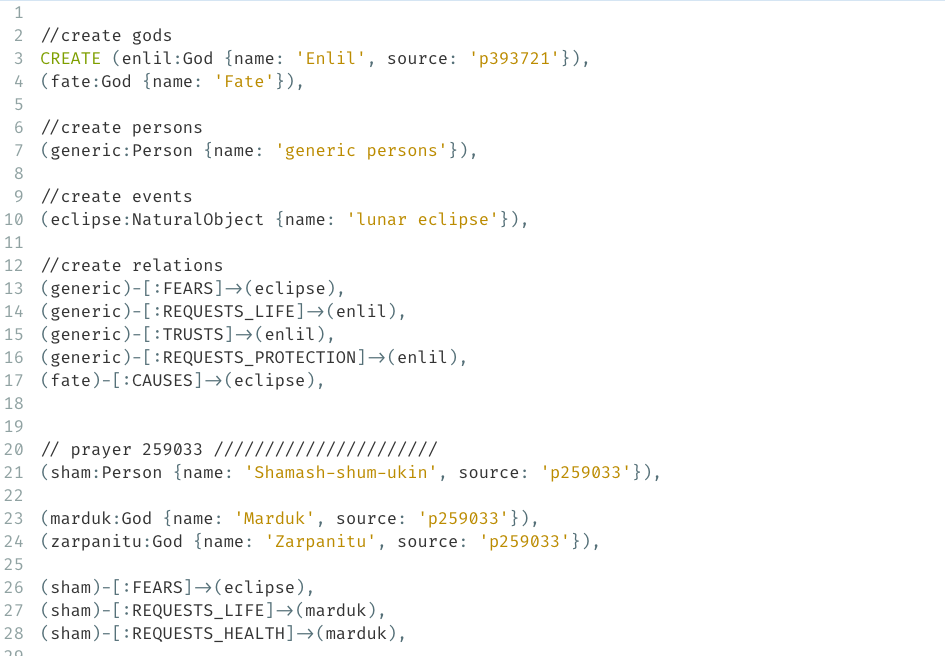
Instead of creating an automatic process through NLP tools, I manually encoded the relations expressed in those texts as a directed graph, using the Cypher language and Neo4j database management software. The Cypher language permits an ASCII-art representation of nodes and edges, as well as a multilayered tagging and properties structure to encode each node and relation with rich data. The first few lines of the encoding is below:
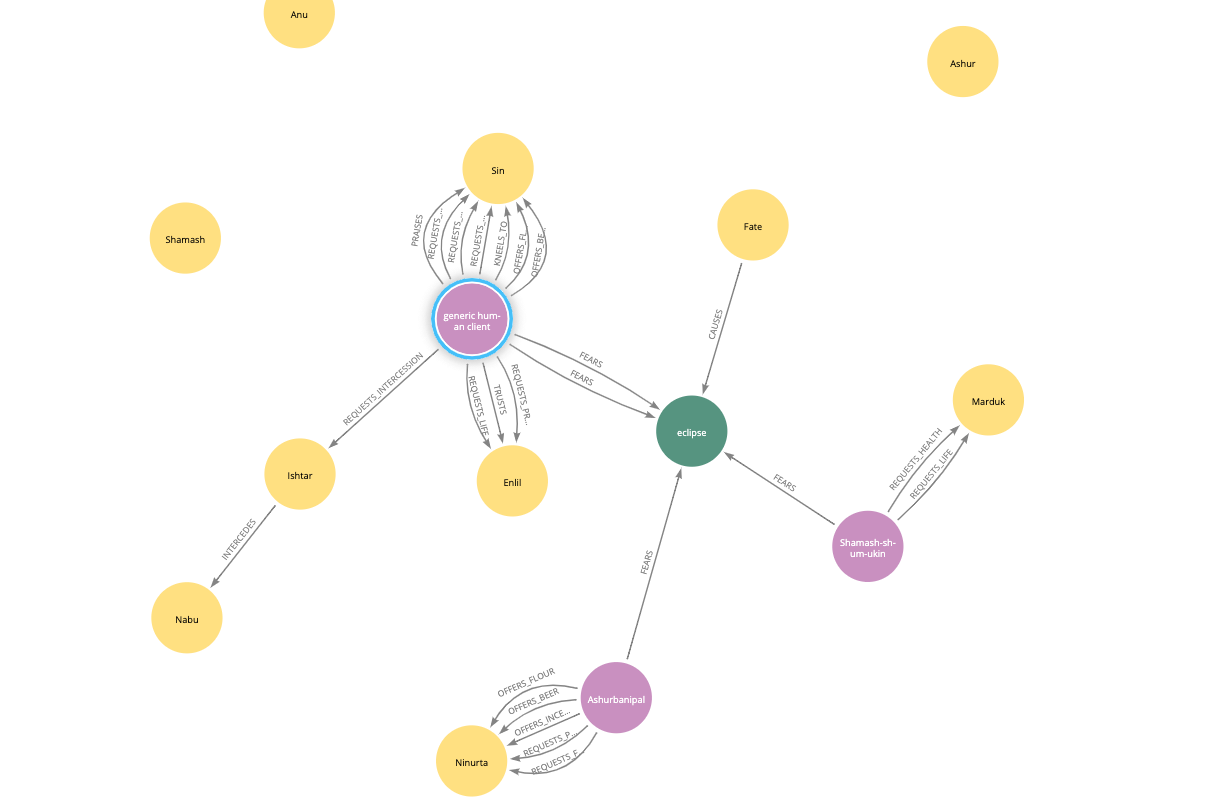
By encoding the texts in this way, they could be visualized using the Neo4j software. The four Mesopotamian texts result in the following image:
The lunar eclipse, represented in green as part of the natural world, is at the center of three “fear” relationships with human persons (in purple) who are praying using the text of the prayers. Some of them are named, some are generic clients of the clerical structures in Mesopotamia. The persons are also connected to several named divinities (in gold) through relations such as PRAISES, REQUESTS_LIFE, and OFFERS_INCENSE. Some divinities are named in the prayers, but not specifically addressed: these float unconnected to the graph.
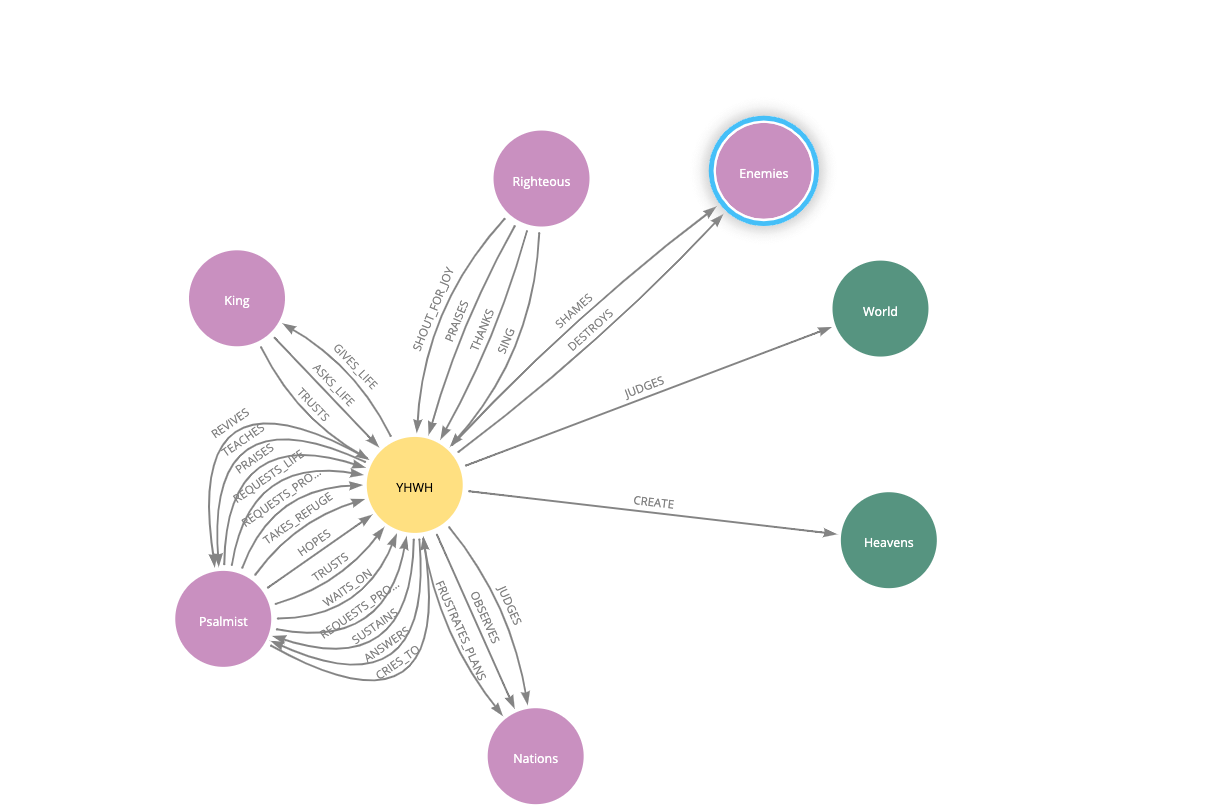
In a similar fashion, the four Psalms can be encoded and represented as follows:
Here, the one God of the Bible, YHWH, is represented at the center of the graph, recipient of relations from the humans such as TRUSTS, REQUESTS_LIFE, and THANKS. YHWH also acts directly on the humans, GIVES_LIFE to some and DESTROYS others. The natural world appears, though not with the importance it has in the Mesopotamian texts.
While this schematic representation is a far cry from the poetic character of the original texts, it does to some extent describe both religions in terms that their own adherents would recognize. The structures encoded in Cypher are a direct translation of the entities and relations present in the religious texts used. While this structural translation is certainly an impoverishment of those texts (the numerous captatio benevolentiae are not encoded, for instance, and the vibrant and various humanity of the Psalms and the anguished opacity of the Shuila prayers hardly appears), the content that can be thus encoded does express some of the essential characteristics of each religion in so far as it expresses the direct relations between humans, divinities, and the natural world.
5. Comparison
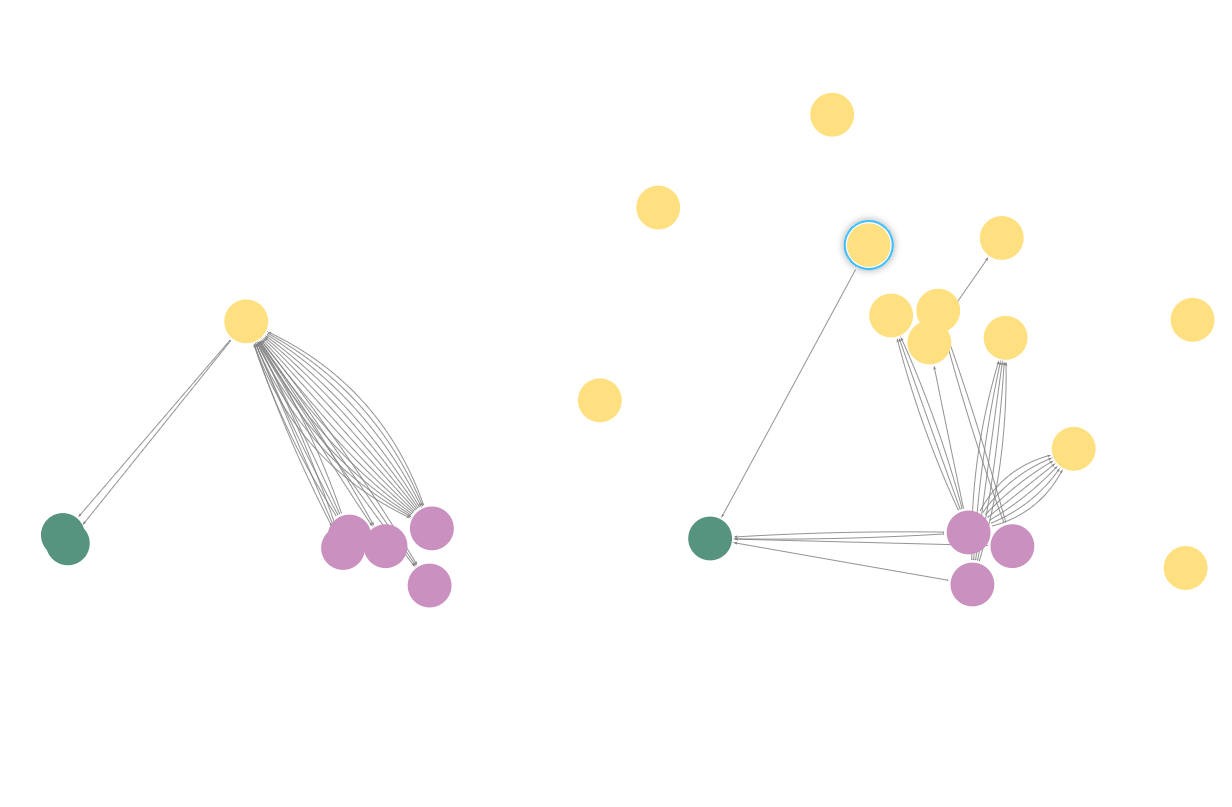
We set out to compare two religions through the identification of a structural “signature” characteristic of each experience. The two graphs presented above were encoded in a single database, and do not touch simply because none of their current nodes are identical. It would be expected that if a large number of texts were encoded, this might no longer be the case. At the current stage of encoding, the two graphs can be compared intuitively by collecting the three types of nodes (divinities, humans, and natural world) in three locations. An example of such a comparison, with Mesopotamia represented on the right and the Bible on the left, is below:
With only four fairly random prayers to represent each religion, the conclusions that can be drawn should be taken with more than a grain of salt. Yet even at this very low resolution, we can already see a few significant differences. While there is a large pantheon forming on the right (Mesopotamia), only one God is on the left (Bible). More importantly, and beyond mere numeric differences, the relations between humans and gods is unidirectional in the case of Mesopotamia, and bidirectional in the case of the Bible. Futhermore, measuring centrality shows that in the case of Mesopotamia, humans are more central, whereas YHWH is more central in the Bible. With a larger graph based on more texts, network analysis would permit more numerous and robust conclusions to be drawn.10
6. Conclusion
Within the limitations of the data I have thus far encoded, one can see distinctly different structures in polytheism and monotheism as expressed in a small collection of the sacred texts of Mesopotamia and the Biblical people. This fact is already relevant to the discussion in the field. For instance, it tends to support the conclusions reached by G. Buccellati in his comparative study (Buccellati 2012). On the opposite spectrum, this work tends to critique the conclusions of M. Smith, who proposed that there is not a difference of kind but rather of degree between Mesopotamian polytheism and Biblical monotheism (Smith 2003). With more data, it might be possible to reach even more interesting conclusions. For example, this method could be applied to study the origins and goals of political structures and the institution of the temple.
Having been encoded as a graph, two religions or spiritualities can be compared by comparing their structures. Since the topology of two networks can be compared independently of the content represented by the network, this method may point toward a way to compare and contrast even those human experiences that are fraught with histories of struggle and misunderstanding.
Notes
1. The longstanding debate about the word “religion” is a salient example.
2. She continues: “Likewise, critics of religion often note how religious systems impose on adherents spiritualizing abstractions that deflect and neglect material needs and realities. As both sets of critics have it, scholarly comparison and religion, imposed from above, easily lend themselves to imperialistic structures of oppression.” On page 7, she writes that “a core critique of comparativism today is of intellectual imperialism, a process that imposes universal categories that distort or disregard locally embedded meanings and differences.” She claims that her book was not intended as a defense of comparativism, and rather that it was the very dynamic of encountering new realities and attempting to “translate” the contents of other people’s experience into her own language that led her to affirm the comparative approach as an “interactive adventure that is never complete, perpetually enticing those who engage into further exploration and discovery.” p. 19.
3. Dempsey maintains that “the key to maintaining productive exchanges between scholar and subject, helping to deflect comparativism’s imperialistic potential, is the resolve to take seriously the religious experiences and expressions of those we study. Although this may seem an obvious suggestion, it appears that the current emphasis religion scholarship tends to place on power dynamics is precisely capable of diminishing this resolve, creating barriers between students of religion and the communities they study.” p. 10
4. Such comparison cannot escape categorization, because human experience forms patterns in the brain and is expressed in patterns of language. It would be interesting to explore the relevance of these issues in a further study.
6. In the background is my research on a linguistic metaphor that was used by some major figures in the study of Mesopotamia to describe the gods of that culture: transitivity and intransitivity. Using NLP dependency parsing, I examined the validity of the transitivity metaphor as it applies to Mesopotamian and Biblical relations between humans and divinities. Other metrics, like keyness, were also calculated and interpreted. See
https://4banks.net/Mes-Rel/temi/transitivity.htm 7. Alan Lenzi, who has studied these prayers extensively and maintains a website archive of all the extant shuila prayers, writes that they are “liturgical ritual-prayers that were directed to the high deities of the Mesopotamian pantheon such as Marduk, Shamash, and Ishtar, among others. A ritual official (i.e., an exorcist) recited these prayers to assist a troubled client, often a Babylonian or Assyrian king. The exorcist would read the prayer aloud and the (presumably illiterate) client would repeat the words after him.” See
http://www.shuilas.org/ 8. On his site shuilas.org, Alan Lenzi writes: “Comparatively inclined scholars in various fields of Religious Studies have used shuila-prayers to shed light on other religious corpora. For example, biblical scholars have been making comparative observations between the biblical psalms and the shuila-prayers in terms of both form and content since the late nineteenth century (Zernecke in Lenzi 2011, 61-68; →
http://www.worldcat.org/oclc/872410762; →
https://www.sbl-site.org/assets/pdfs/pubs/9781589835962_OA.pdf).”
9. Specifically: prayers with CDLI numbers 259033, 393721, 393771, and 393796 on Lenzi’s site shuilas.org. The prayers, with original cuneiform text as a photo, complete with transcription and translation, can be found by replacing the number in the URL:
http://shuilas.org/P398671.html. The Psalms do not deal with lunar eclipses, so for a random first test corpus I simply used the last two digits of the Shuila prayers as references. Thus the psalms encoded are numbers 33, 21, 71, and 96 in the numbering of the Revised Standard Version (RSV). All prayers and psalms were encoded according to their English translations as available on shuilas.org and in the RSV.
10. It seems that Fitz John Porter Poole dreamed of something like this comparison in his seminal article of 1986, but it was not yet possible with the technology of the day.