1. Introduction
As the first wave of Covid-19 virus spread across the world, content alignment of news stories could be observed both within and between media sources. During December 2019 and February 2020, Covid-19 news stories were, outside China, interspersed with news coverage of other events (e.g., Hong Kong protests, Iranian–American confrontation, Trump impeachment). As the virus spread across Europe and America, news media front pages focused almost exclusively on the pandemic, all news sections (politics, business, sports, and arts) related to Covid-19, and breaking news became corona news in continuously updated media. From the perspective of cultural dynamics, the Covid-19 pandemic provides a natural experiment that allows us to study the effect of a global catastrophe on the dynamics of news media's information. While news media are neither unbiased nor infallible as sources of events, they do reflect preferences, values, and desires of a wide socio-cultural and political user spectrum. As such, news media coverage of Covid-19 functions as a proxy for how cultural information systems respond to unexpected and dangerous events.
Previous studies have shown that variation in newspapers' word usage is sensitive to the dynamics of socio-cultural events (Guldi 2019 / Eijnatten et al. 2019 / Daems et al. 2019), can detect event-driven shifts (Kestemont et al. 2014), and accurately can model effects of change in comprehensive collections of newspapers (Bos et al. 2016). Furthermore, the co-occurrence structure of newspapers has been shown to accurately capture thematic development (Newman et al 2006), and, when modelled dynamically, is indicative of the evolution of cultural values and biases (Eijnatten et al. 2019 / Wevers 2019). Adaptive smoothing and fractal analysis of word frequencies over time have been used to identify distinct domains of newspaper content (e.g., advertisements vs. articles) (Wevers et al. 2020) and to discriminate between different classes of catastrophic events that display class-specific fractal signatures in, among other things, word usage in newspapers (Gao et al. 2012). Several studies have shown that measures of (relative) entropy can detect fundamental conceptual differences between distinct periods (Guldi 2019), concurrent normative and ideological movements (Barron et al. 2018), and even, development of ideational factors (e.g., creative expression) in temporally dependent writings (Murdock et al. 2015 / Nielbo et al. 2019a, 2019b). More specifically, a set of methodologically related studies have applied windowed relative entropy to thematic text representations to generate signals that capture information novelty as a reliable content difference from the past and resonance as the degree to which future information conforms to said novelty (Barron et al. 2018 / Murdock et at. 2015). Two recent studies have found that successful social media content shows a strong association between novelty and resonance (Nielbo et al. 2021), and that variation in the novelty-resonance association can predict significant change points in historical data (Vranbæk et al. 2021).
In this study we expand upon studies of novelty and resonance in cultural dynamics by modeling change in printed news media during the initial phase of Covid-19. Specifically, we propose the empirically derived principle of News Information Decoupling, which explains how the information flow in legacy media responds to catastrophic events.
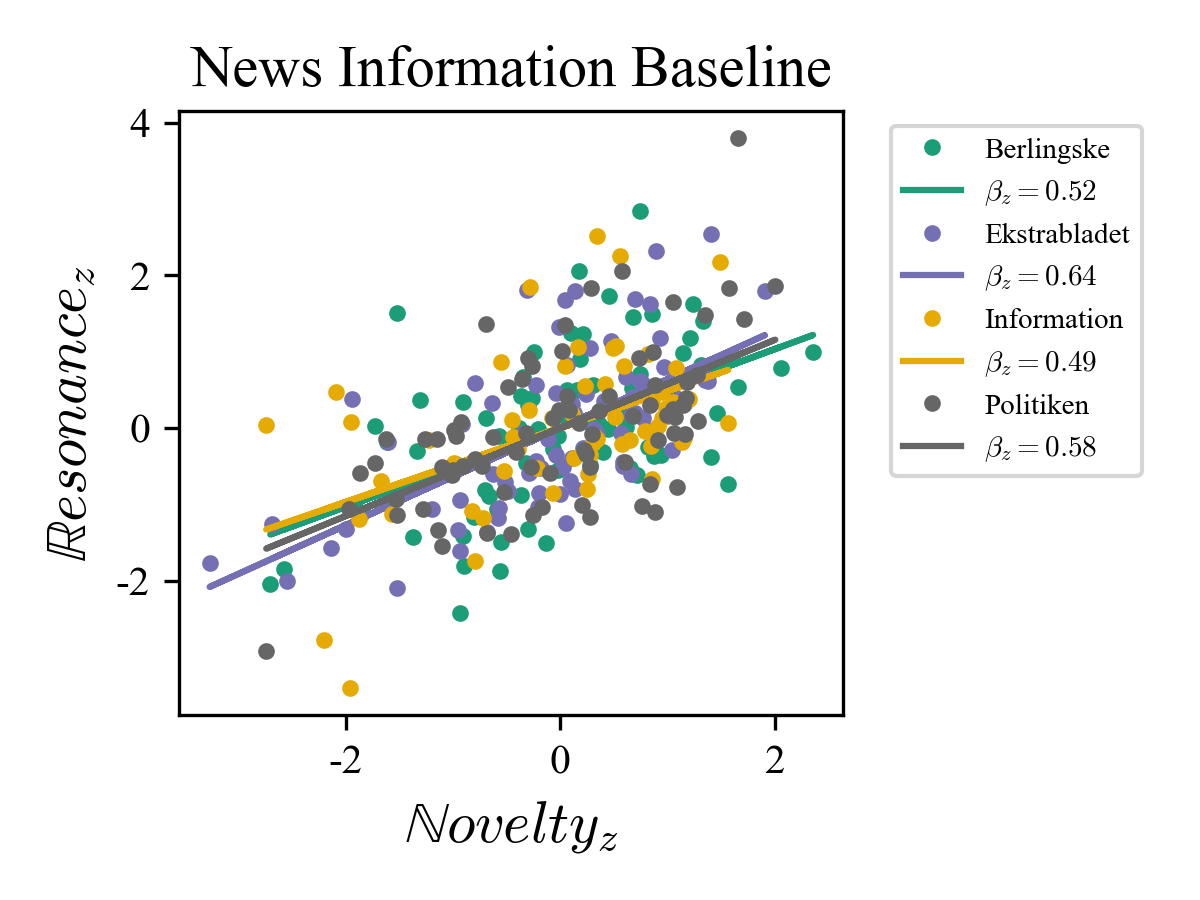
Figure 1: ℕ × ℝ slope baseline for four national newspapers that represents the left-right political spectrum. Data are sampled before Covid-19 phase 1 in Denmark initiated.
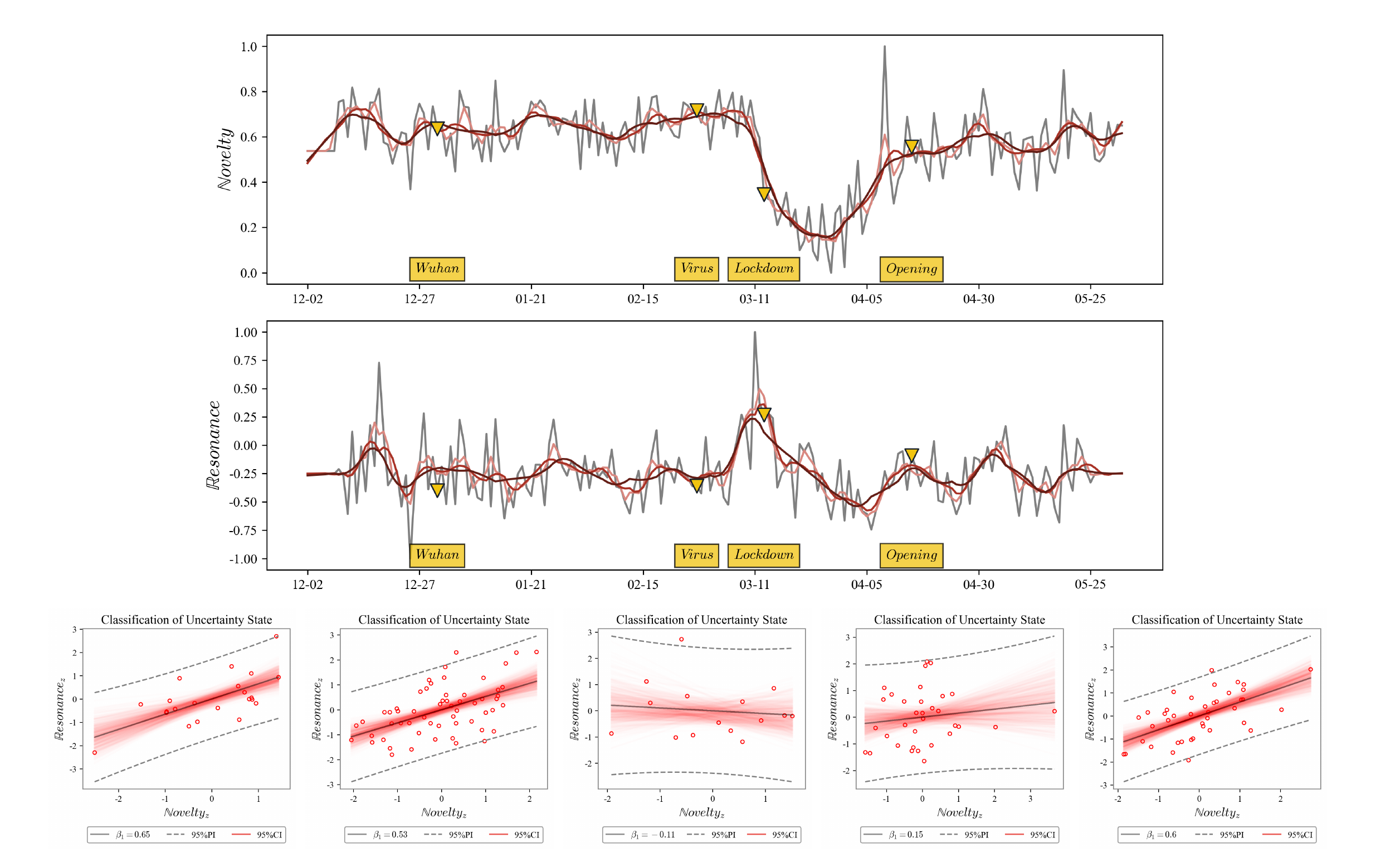
Figure 2: Novelty (upper panel), resonance (middle panel), and event-defined ℕ × ℝ slopes (lower panel) for center-left newspaper Politiken before and during Covid-19 phase 1.
2. Results
The reported results are based on a sample of fours national newspapers in Denmark that collectively represent moderate-left ( Politiken) and moderate-right ( Berlingske), and left ( Information) and right-wing political observation ( Ekstrabladet). This paper focuses on moderate newspapers during phase 1 of Covid-19, but all results have been confirmed for the full political spectrum as well as all national newspapers in Denmark (see Appendix for details on methods and data).
To establish a baseline for novelty and resonance, we computed the pr. newspaper linear slope for resonance on novelty ( ℕ × ℝ) from December 01, 2019 to February 26, 2020 (the first case of Covid-19 in Denmark was registered on February 27, 2020). As can be observed from Figure 1, the slopes are remarkably similar, indicating a medium to strong association between novelty and resonance ( M=0.56, SD=0.06) before the national outbreak of Covid-19. In the normal state of affairs, novelty and resonance therefore seem to be coupled such that novel news items tend to resonate more than overused and repetitive items and vice versa. This general news dynamic confirms the intuition that news media, all things being equal, maintain their relevance by propagating news.
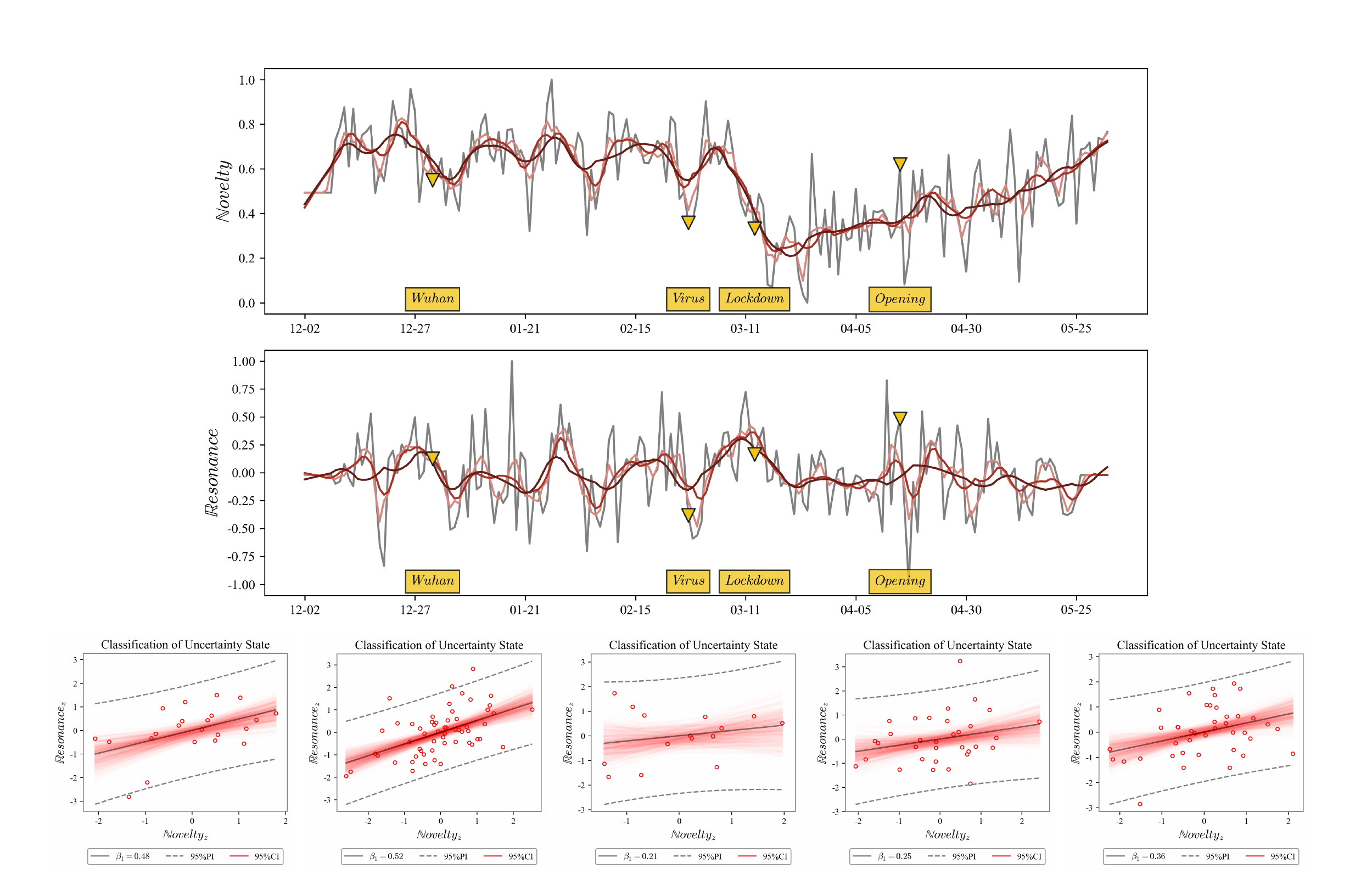
Figure 3: Novelty (upper panel), resonance (middle panel), and event-defined ℕ × ℝ slopes (lower panel) for center-right newspaper Berlingske before and during Covid-19 phase 1.
The normal state of affairs was however severely disrupted by the rapid spread of Covid-19 and following lockdown on March 13. For Politiken in Figure 2 it is apparent that between the first case (‘Virus’) and the ‘Lockdown’ there is a non-linear decrease in novelty (upper panel) which is countered by an inverted resonance response (middle panel). This initial decoupling of novelty and resonance does, in other words, coincide with the catastrophic Covid-19 event. While slightly less pronounced, the same decoupling patterns can be observed in Berlingske, see Figure 3. In fact, decoupling of novelty and resonance can be observed in all national broadsheet newspapers irrespective of political observation and rare news phenomena where all news items are concerned with one event for an extended period of time (>3 weeks).
An interesting contrast that may be politically motivated can be observed around the phase 1 ‘Opening’ at April 15. While the center-left newspaper Politiken was quite fast at re-establishing an almost normal state of affairs, the center-right Berlingske showed a delayed linear novelty response for the remainder of the first phase. This is likely to reflect the level of support for the center-left government's decision making regarding lockdown and opening. The center-right newspaper seems to retain the decoupling for longer as they continue to focus on the economic and societal consequences of the government's Covid-19 policies.
The ℕ × ℝ computed on event-defined windows, e.g., ‘ Lockdown→Opening’, can be used for simple change detection technique, see Figures 1 and 1 lower panels. As phase 1 unfolds, the decoupling is observed as loss of association between novelty and resonance. In the ‘ Virus→Lockdown’ window (middle plot in lower panel), the slope approaches zero (for Politiken the slope is actually negative), when the decoupling is most pronounced. The partial return to normal can be observed in the (dis-)similarity between ‘ → Wuhan’ and ‘ Opening→’ ( Politiken: 0.65→0.6, and Berlingske: 0.48→0.36).
3. Concluding remarks
In conclusion we propose the empirically-derived News Information Decoupling (NID) principle, which states that in response to unexpected and dangerous temporally extended events, the ordinary information dynamics of news media are (initially) decoupled such that the content novelty decreases as media focus monotonically on the catastrophic event, but the resonant property of said content increases as its continued relevance propagates throughout the news information system. As such, NID behavior of the news information flow is a signature of catastrophes. At the level of methodology, this paper has illustrated how NID behavior of legacy media can be identified using non-linear adaptive filtering and windowed linear fits for resonance and novelty, and function provide input for change point detection algorithms.
There are multiple research paths that could contribute further to our understanding of NID. First, the predictive value of NID should be validated in terms of crisis management; second evaluation of NID's event scope is necessary, for instance, does NID only apply to a small set of negative events or does it generalize to a substantially larger set of significant events (e.g., moon landing, fall of the Berlin wall); third, comparisons of information micro-behavior as a function of newspaper values, for instance, left vs. right-wing newspapers or tabloid vs. broadsheet newspapers; and finally, multilingual validation of NID.
Appendix A Methods
Appendix A.1 Data and normalization
The data set consists of all linguistic content from front pages of four Danish national newspapers Politiken, Berlingske, Information and Ekstrabladet, sampled during December 1, 2019 to June 1 2020. In order to normalize linguistic content, numerals and highly frequent function words were removed, and the remaining data were lemmatized and casefolded. Subsequently, the data were represented as a bag-of-words (BoW) model using latent Dirichlet allocation in order to generate a dense low-rank representation of each article. Novelty and resonance were estimated for in windows of one week ( w = 7).
Appendix A.2 Novelty and resonance
Two related information signals were extracted from the temporally sorted BoW model: Novelty as an article s (j)'s reliable difference from past articles s (j-1) , s (j-2) ,…,s (j-w) in window w:
and resonance as the degree to which future articles s (j+1) , s (j+2) ,…,s (j+w) conforms to article s (j):
where 𝕋 is the transience of s (j):
The novelty-resonance model was originally proposed in (Barron et al. 2018), but here we propose a symmetrized and smooth version by using the Jensen–Shannon divergence ( JSD):
with M=1/2( s (j) + s ( k ) ) and D is the Kullback-Leibler divergence: