Philipp, Luisa
Beuth Hochschule für Technik, Germany
luisa.philipp@beuth-hochschule.de
Kreutel, Jörn
Beuth Hochschule für Technik, Germany
joern.kreutel@beuth-hochschule.de
In current practice of software development for digital humanities (DH) applications, the consideration of an application’s usability as a major factor for user acceptance can still not be taken for granted (Thoden et al. 2017), (Lehenmeier / Burghardt 2019). However, particularly for projects that focus on data collection in some field, not only the initial project success, but also the longer-term dissemination of project results as well as continuous scientific cooperation based on a project’s outcome will depend on the accessibility of data collections to domain experts beyond the actual project participants. This lets usability appear to be a relevant curation aspect with regard to the collected data.1 Yet, considering recent publications, neither the question of how domain experts may intuitively access structured data using appropriate query tools as a prerequisite of various types of analyses, nor the usability of such tools seem to receive major attention in DH, where existing work has a strong focus on the SPARQL language (Harris / Seaborne 2013), rather than dealing with the issue of query creation in a more generic way.2
Our contribution will report on ongoing development of a web-based software platform for collecting and analysing bio-bibliographical data for literary studies on GDR authors,3 and will present findings from the evaluation of a query editor that allows domain experts to compose complex queries. Applying a user-centered design methodology (Abras et al. 2004) and given the information needs of the project participants, the editor was supposed to provide an “expert mode” alternative to an existing free text search interface and should particularly support the formulation of complex queries involving relations between various entities of the underlying data model and constraints on the latter.4 Technically, the editor should not depend on a particular data storage paradigm or query language, but should employ an abstract query representation mappable onto particular query languages like JPQL (DeMichiel / Jungmann 2017) or SPARQL. In order to be portable to alternative domains and as the domain model for data collection had been iteratively developed by domain experts and software engineers, it was expected to adapt to the respective model structure.
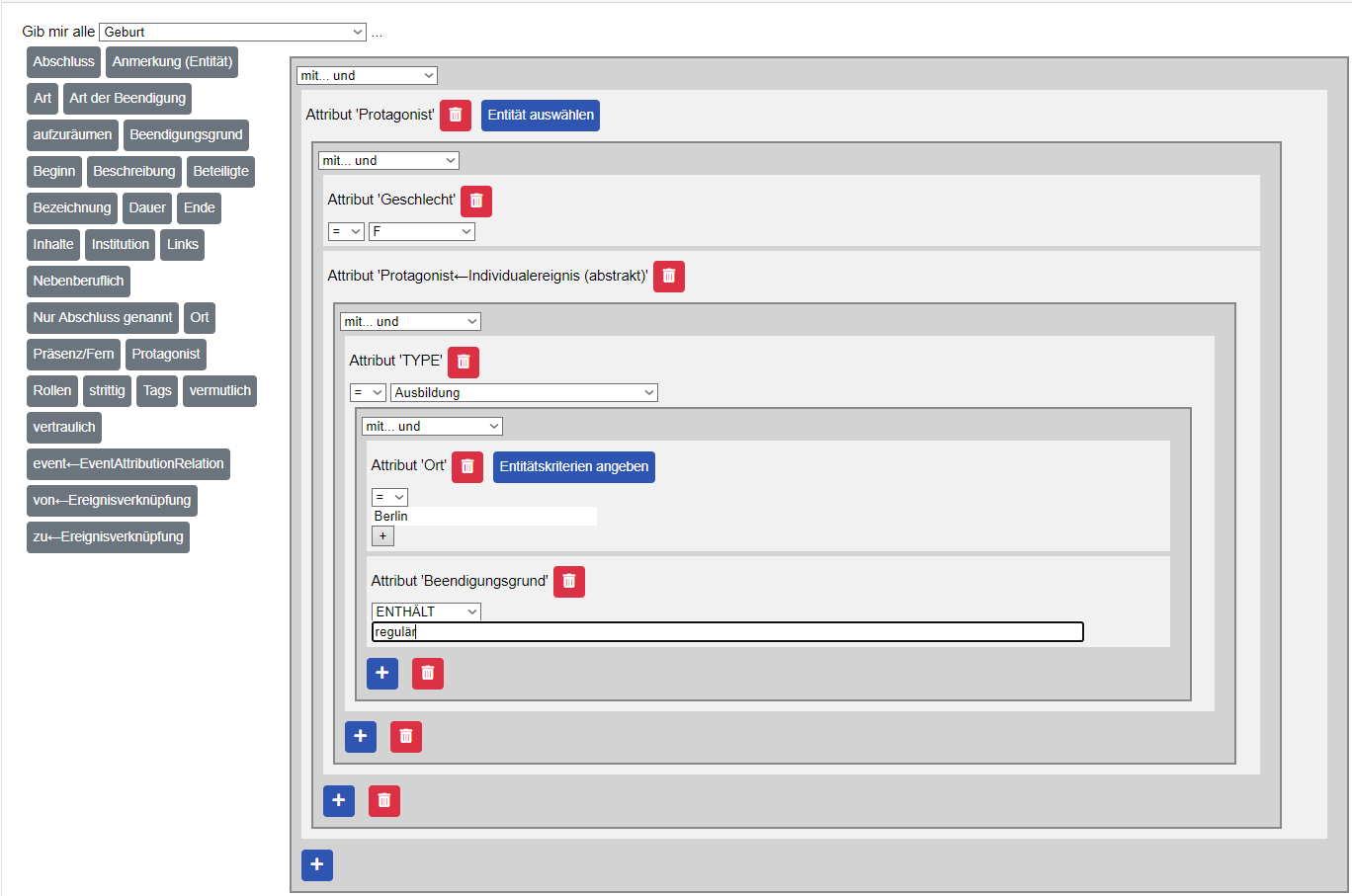
Starting with interviews for finding out the German literature domain experts’ information needs, overall technical affinity and experience with query interfaces, and considering their design preferences known from cooperation within the project, the design of the editor basically adheres to a form-based, rather than an icon-based or diagram-based approach (see Catarci et al. 1997; Lloret-Gazo 2016 for this distinction). As the figure below shows, it uses embedded structures for expressing conditions on entities that involve relations to other entities,5 where relations can be both expressed on the basis of an entity’s own outgoing associations and based on their “incoming” usage within other entities, thus allowing flexible entry points into query formulation. Natural language style labels (e.g., “Gib mir alle”, “mit... Attribut”, etc.) support intuitive readability of the created query.
Representation of a query retrieving birth events for female persons who have regularly completed an education in Berlin. In a similar way, the projection of the query, which specifies which attributes of the selected entities shall actually be included in the query result, can be formulated. For this example, the projection could include, e.g., the names of the persons, the dates and places of birth and the types and periods of the retrieved education events.
Following Jakob Nielsen’s 5-users-rule for usability testing (Nielsen 2000)6 , the editor has, so far, been evaluated with six domain experts, whose majority was familiar with the domain model in terms of entity types and their attributes and associations as they had already applied that model for data entry. Each tester carried out five supervised retrieval tasks that were expressed in written natural language, where complexity gradually increased. Applying the think-aloud method (Van Someren et al. 1994), observable obstacles and explicit questions of test persons were tracked by the supervisor. All tasks could be completed successfully by all testers, where the majority of unclear issues could be solved by the testers themselves without requiring help by the supervisor. Where help was necessary, this was mainly due to conceptual aspects of the domain model that had not shown up during the latter’s usage for data collection, like the notion of an entity’s “incoming” associations. However, once the respective questions had been clarified, testers were able to successfully apply their increased knowledge in subsequent tasks.
Given the objective to make the platform available to external domain experts, the findings from the tests show, on the one hand, that future versions of the editor should improve access for users unfamiliar with the domain model.7 On the other hand, provided the latter knowledge, the tests also reveal that particular technical experience or familiarity with “expert mode” search interfaces is not a prerequisite for successful creation of even complex queries that involve entity relations. Consistently with this observation of the testers’ objective achievements, also the evaluation of the users’ subjective experience on the basis of the user experience questionnaire (Laugwitz et al. 2006) shows an overall positive attitude and perception of, among other aspects, the editor’s learnability and ease of use. Hence, the evaluation appears promising with respect to the platform’s objective to support domain experts’ research interests by providing user interfaces with good usability.
See the overview in Zuiderwijk et al. (2020), which mentions poor usability of “complex user interfaces” for querying as an inhibitor of data reuse.
See Heibi et al. (2017) for a recent proposal of a generic query infrastructure based on SPARQL that includes a usability analysis, as well as Russel / Smart (2008), Ambrus et al. (2010) and Soylu et al. (2016), which are not focussing on DH scenarios, though. For the relevance of structured querying for domain experts, see, e.g., a two-week summer school course from 2018 on “Asking questions to data in the humanities: right, correct, efficient” dealing with XQuery, SQL and SPARQL (https://esu.culintec.de/?q=node/942, last accessed on May 20, 2021). As for the EADH2021 conference, however, the fine-grained classification scheme for contributions via ConfTool, in contrast to the CfP, does not mention querying as an activity of its own in the context of data analysis.
See http://www.ddr-literatur.de/ for further details. The project is funded by Deutsche Forschungsgemeinschaft (DFG), grant number 419244741. The authors would like to thank their project partners from Humboldt University of Berlin and the Berlin Brandenburg Academy of Sciences and Humanities, who participated in the user interviews underlying the work presented here.
See, e.g., the following example queries: “ What is the gender/year-of-birth/birthplace etc. of authors associated with a given institution (e.g., a writer’s association, university, etc.)? ” – “ Which jobs did writers have before/after their first publication? ” – “ Over time, which were the publishing houses issuing publications of authors that were associated with a given institution?
The underlying abstract query representation allows the usage of variables for coindexation of entities and is, hence, more expressive than a mere tree structure. Integration and end user tests of this advanced feature will be done at a later stage of the project, though.
See, e.g., Faulkner (2003) for an investigation of the limitations of this principle.
This could be achieved, e.g., by interactive tutorials, which could apply proposals for knowledge transfer based on “example-driven modelling” (Bak et al. 2013) to the case of query formulation.