Rusinek, Sinai
Elijah Lab, Haifa University, Israel
sinai.rusinek@mail.huji.ac.il
Elovits, Dror
Elijah Lab, Haifa University, Israel
dror.elovits@gmail.com
Sharara, Aseel
Elijah Lab, Haifa University, Israel
aseelsh1@gmail.com
Lavee, Moshe
Elijah Lab, Haifa University, Israel
moshe.lavee@gmail.com
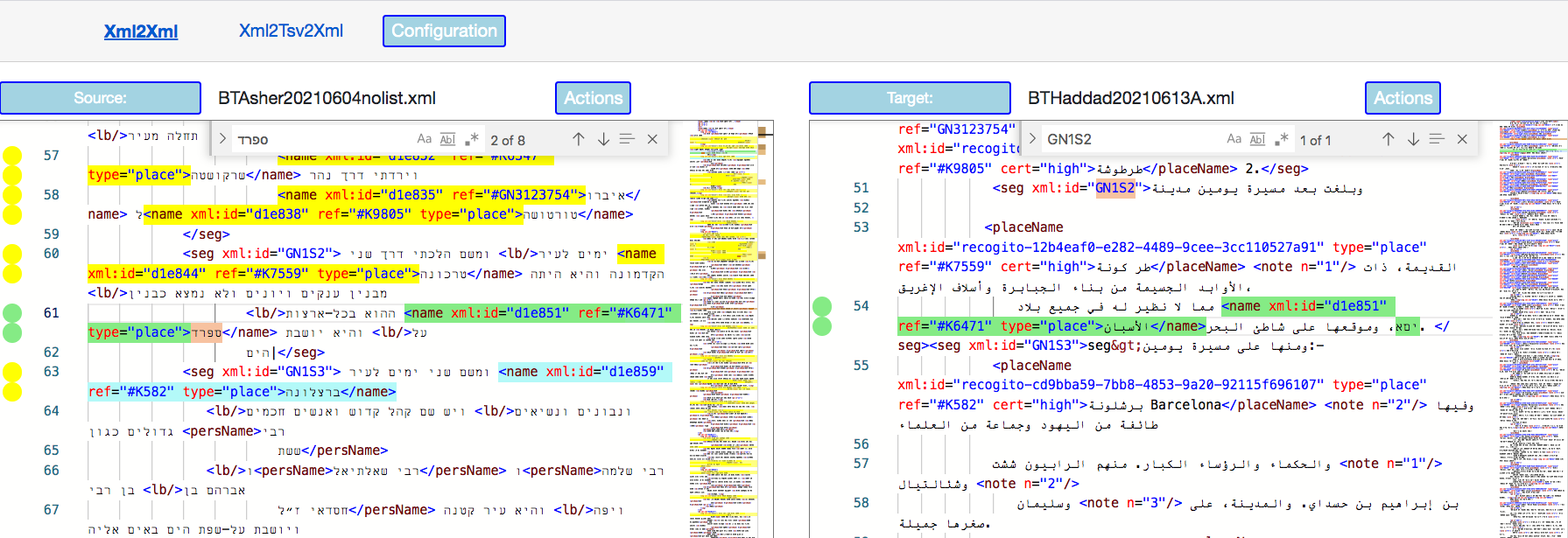
Travel itineraries provide a rare and fascinating window to material and everyday lives and cultures of historical periods, aspects which are not always accessible to us through other literary genres. TraveLab, a 2-year project at Elijah Lab Digital Humanities Laboratory explores the ways in which a digital edition can be devised to enable close and distant reading in parallel editions and maps. As its main case study, it focuses on the creation of a tri-lingual edition of the Medieval travel narrative of Benjamin of Tudela (12th c.). For the English translation, we used Nathan Adler’s (Adler 1904) Gutenberg HTML edition, in which the Hebrew part is missing. For the Arabic, we used Ezra Haddad (Haddad, 1945) translation which was made available in a Markdown version at the Open Islamicate Texts Initiative (OpenITI). The 19th c. Hebrew print edition by Adolph Asher (Asher 1840) was digitized using the Transkribus platform and a trained model for Hebrew print. Place and Person names were annotated, classified and linked using the open Pelagios platform Recogito, and further enrichment and structuring was done using Open Refine and Oxygen Editor. For the purpose of transferring the rich layers of structure, annotation and linking to the English and Arabic editions, a custom-built suite of tools, the XM-Planter, was designed for us by DH-Dev (XML-Planter).
Figure 1: the XML-Planter at work 1
Historical travelogues have acquired a canonical position - some more than others, so that they are featured in multiple printed editions and translations, and assembled in several anthologies. 19th and 20th century philology has especially garnished them with the scholarly technologies of the printed text: it enriched them with critical apparatus, indices and maps, and included commentary which addressed issues of identification of the places, people and events mentioned in the text, or the borrowing of content from different sources. The TraveLab project aims to preserve these layers of scholarly paratext in our digital editions.
Transferring travelogues and itineraries, handwritten and printed, from the linear writing mode to digital media enables both revisiting, augmenting and updating traditional scholarship; But it also opens opportunities for shedding new forms of light on them. Travelogues are, in fact, often composed from the start as potential databases, grids of data: spatial, prosopographical and relational grids in which travel narratives, descriptions and histories of places and peoples are embedded. Due to this structured nature, digitizing may sometimes seem as liberation of the data from travelogues’ linear textual medium into more appropriate media.
But what are the forms that are called for in the new digital medium? How can the map be situated in the midst of the tension - or symbiosis - between narrative and database?
In our TEI structural annotation scheme we chose to model the edition using “geo-narrative” units and subunits that take into account on the one hand, the inherent database-like form of the text, and on the other, a vision for a “mapedition”, a reading device that will fuse co-aligned texts and maps, witnesses and commentary.
Digital textual scholarship of the last decades has already developed new forms of dealing with editions of multiple witnesses and translations, replacing classic apparatus criticus with more flexible, interactive synoptic views. While georeferencing has been entrenched as a practice for analysis and visualization, we are still at an incunabula stage in addressing the intimate relation of narrative and map. In the proposed poster we will share the deliberations and fruits of our exploration and experimentation in search for a digital model for travelogue editions and their scholarship.