1. Introduction
On Liberty is a classic of modern political philosophy and arguably the single most influential text expounding liberalism. It argues for limiting the power of governments and society collectively by distinguishing a public and a private sphere. State power is only legitimately wielded in the public sphere, but individuals are entitled to do whatever suits their preferences – provided they do not harm others – in the private sphere.
The author of On Liberty, published in 1859, is generally agreed to be the most important British philosopher of the 19th century, John Stuart Mill. At least, his name is on the cover. We believe that his wife, Harriet Taylor Mill, has contributed significantly more than what she has been given credit for. To this end, we are performing a stylometric analysis using Stylo (Eder et al. 2016). If the results show that Harriet Taylor Mill has made a non-negligible contribution, her name should also be on the cover.
The case of John Stuart Mill (hereafter JSM) and Harriet Taylor Mill (HTM) is of particular interest. Ever since their meeting 1830, their relationship has been frowned upon. At the time, HTM was married to her first husband, John Taylor, and was expected to play the role of wife and mother. This was not a role JSM saw her in, who instead spoke highly of her intellectual capacities and considered her an intellectual equal. They published some newspaper articles under both names, and worked together on many texts, primarily in social philosophy. Most of these were published under the name of JSM, however, even though he often says that they were ‘joint productions’ (MacMinn et al. 1945). There is clear evidence that who was to appear on the cover was at least sometimes a strategic decision, made in light of their socially inappropriate relationship and the lower credibility of HTM as female intellectual.
Historical research has been undertaken to set the record straight (Jacobs 1998; McCabe 2016), but the historical evidence has now been exhausted. No stylometric analysis has been performed yet, however, as stylometry is almost unknown in philosophy (except for ancient philosophy, see e.g. Kenny 1978 and Kahn 1996). In what follows, we are decribing how we prepared the corpus, what analyses we performed, and what the results are.
2. Preparing the Corpus and the Class Imbalance Problem
We used two major sources: John Stuart Mill’s Collected Works in the Liberty Fund online edition (originally edited by John Robson 1963-1991), and Harriet Taylor Mill’s Complete Works as edited by Jo Ellen Jacobs (1998), also available to us in an electronic version.
To avoid genre effects, we did not include letters of either, debating speeches of JSM, and poems and songs by HTM. We also didn’t include the text “The Life of William Caxton” published under the name of HTM, even though this is a long text and thus would provide a lot of evidence for her stylome. As Jacobs (1998: 237), the most careful edition of HTM’s work by the most distinguished specialist on her life and work points out, there is compelling historical evidence that this was co-authored with (at least) her then husband John Taylor. We also excluded all texts not written from 1830-1858 (except for Utilitarianism, first published in 1861 but mostly written before 1858), the phase of their cooperation, which ended with the death of HTM. We also followed Jacobs in dividing the Principles of Political Economy into two parts and attributed Book 4 ch. vii to HTM and the rest to JSM. As far as the co-authored texts are concerned, we first included all those actually published under both of their names. The MacMinn et al. (1945) volume Bibliography of the Published Writings of John Stuart Mill provides a lot of evidence, in the words of JSM, on HTM’s contributions on texts published under JSM‘s name. However, as only published works are included in that volume, we decided again to follow Jacobs‘ (1998) attributions, which further include many previously unpublished writings (it needs to be noted that further relevant unpublished work by HTM may well be found in the future). Finally, we prepared one corpus including also all newspaper articles and one excluding them. Because newspaper articles are written in a different style than more academic books or papers, it is plausible to expect a genre effect, and a cluster analysis on the entire corpus confirmed this (the newspaper articles clustered together). Unfortunately, most of the co-authored pieces are newspaper articles, so by excluding them, we would also exclude most of the co-authored items. Thus we did all our analyses twice, once on the corpus with and once on the corpus without the newspaper articles. The final corpus consists of 212 texts by JSM, 37 texts by HTM, and 23 co-authored pieces.
We cleaned the texts of all titles, quotations from other authors, commentaries or prefaces or footnotes by the editors, and any foreign-language passages, even if contained in the original, either manually or using a script in Tampermonkey and Java.
Because JSM has written so much more than HTM and them jointly, our corpus is imbalanced. This might lead to various inaccuracies if not compensated. We therefore followed the most successful procedure suggested in Stamatatos (2008) to address this problem (his ‚method 4‘ which rebalances the data by resampling). As we had to run a large number of tests, we wrote a script in Python to automatise this procedure. We ran 100-fold cross-validation.
3. Stylometric Results
We started off with a standard cluster analysis on the entire corpus. There, On Liberty clusters most closely with texts authored by JSM. This is not surprising, as even if HTM did contribute significantly, her stylome would almost certainly not be strong enough to push the text closer to her own writings. We are looking for collaboration, not single authorship by her.
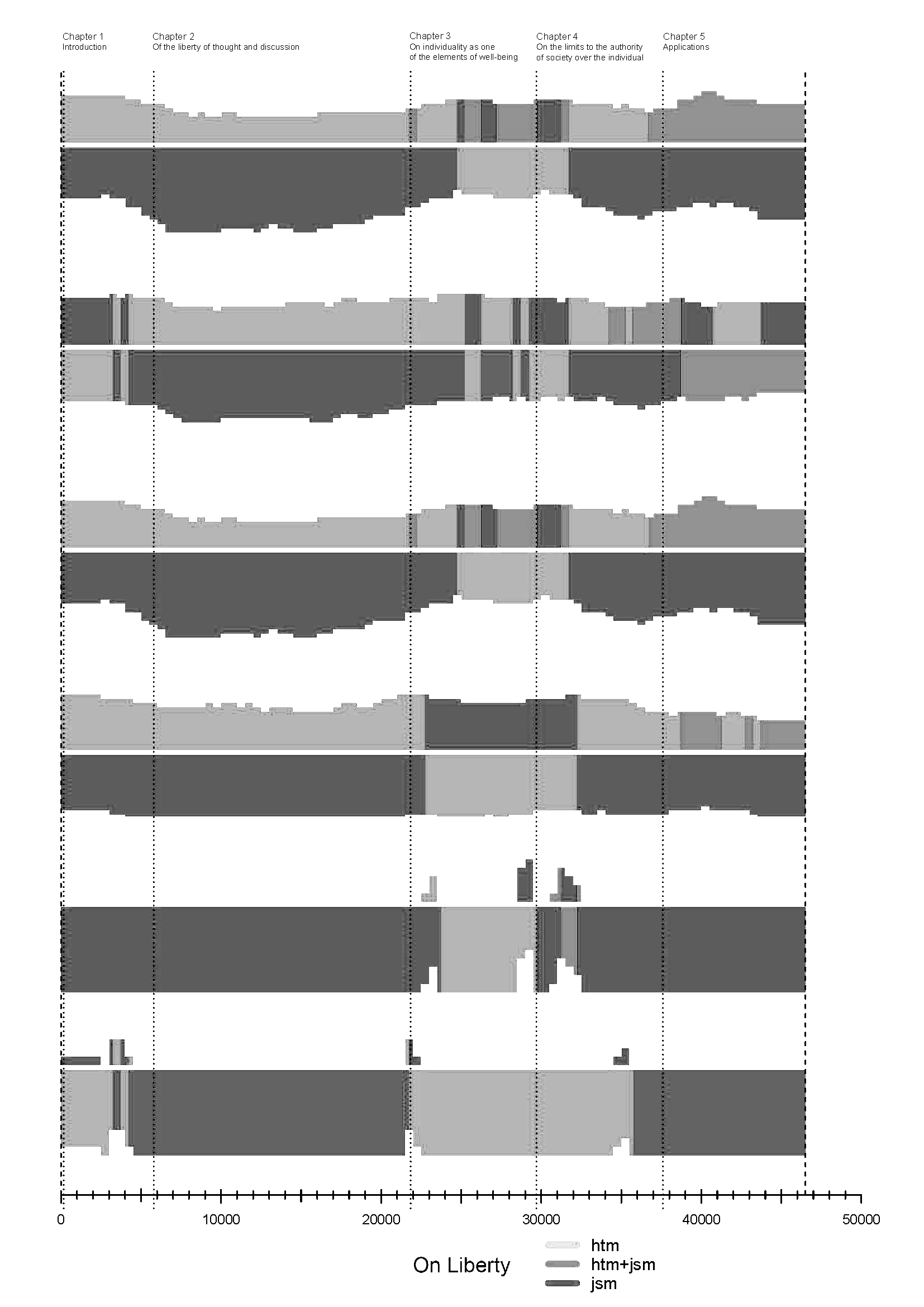
The adequate Stylo setting for our project is obviously a rolling classify analysis (Eder 2017). Because we wanted a comprehensive picture, we decided to run both SVM and NSC algorithms on a large number of settings. For the final analysis we chose the settings by optimising a macro-averaged F1 measure on the resulting confusion matrices. We chose the highest F1 score in absolute terms for both SVM and NSC, as well as the highest F1 score using the sampling method, and also included the two corresponding SVM analyses with the highest F1 score on only JSM and HTM, disregarding the joint authorship. The results are shown below (four SVM and two NSC analyses, for the precise settings see Schmidt-Petri et al. forthcoming, in which we also discuss normative implications of our analysis).
The diagram shows the most likely author at the bottom part and the second-most likely author at the top, respectively. The longer the lines, the higher the confidence. The results of our analysis are clear: Harriet Taylor Mill is the most probable author of some sections of On Liberty on all analyses. In fact, all analyses converge in judging that she most probably authored some parts towards the end of chapter 3. This signal is rather weak on the second diagram, but very strong on all others. On the top three diagrams, we also see a clear signal of co-authorship in chapter 5, and co-authorship is indeed most probable for almost all of chapter 3 on the fourth diagram. Two diagrams (the first and the third) also give JSM&HTM as second-most likely author of large parts of chapter 3. For John Stuart Mill, the clearest result is his authorship of chapter 2. Chapter 1 already is not as clear, as the second diagram assigns it to HTM, and even in the first and third diagrams he is only a little bit more likely to be the author than HTM. Looking at the relevant confusion matrices (not shown), it furthermore becomes clear that the contribution by JSM is likely to be overestimated, that is, HTM is likely to have written even more than shown in the rolling classify analyses.
4. Conclusion
Using the work of Jo Ellen Jacobs on the cooperation between John Stuart Mill and Harriet Taylor Mill as our starting point, our stylometric models strongly suggest that Harriet Taylor Mill authored significant parts of On Liberty, normally attributed to her husband only. The attribution is philosophically plausible: the parts attributed to her deal with subjects closer to her philosophical interest, whereas those always attributed to him deal with themes he previously had written on. Given the influence of On Liberty, this is a result of major interest for the history of philosophy.